Buying Backlinks for SEO, Risks, Costs, and Smart Strategy
Buying backlinks is one of the most debated tactics in search engine optimization. Some marketers swear by it. Others warn about penalties and wasted budgets.
The truth sits in the middle.
Backlinks remain a strong ranking factor in Google’s algorithm. PageRank, referring domains, anchor text, and authority signals still influence SERPs. At the same time, Google Webmaster Guidelines clearly restrict link schemes that manipulate rankings.
So the real question is not whether buying backlinks exists. It is whether you understand how search engines evaluate them, and how to manage risk properly.
Let’s start with the foundation.
What Buying Backlinks Really Means in SEO
A backlink is an inbound link from one website to another. Search engines treat it as a signal of trust and relevance.
When you pay a site owner to place a link inside content, you are purchasing exposure and potentially PageRank flow. That transaction may involve:
- Guest posts
- Niche edits
- Sponsored content
- Editorial placements
- Private blog networks
The mechanics are simple. Money exchanges hands, and a link appears inside a page.
The impact depends on several factors:
- Domain Authority or Domain Rating
- Relevance between linking page and target page
- Anchor text distribution
- Follow or nofollow attributes
- Outbound link patterns
- Organic traffic levels
Google does not see the payment itself. It evaluates signals around the link. If those signals resemble a link scheme, devaluation or manual action can follow.
Modern search also considers AI Overviews and authority modeling. Large language models reference trusted domains more frequently. High quality editorial links increase visibility beyond traditional blue links.
Still, context matters more than ever.
Rel attributes such as rel=”sponsored” and rel=”nofollow” tell crawlers how to treat links. A dofollow link passes ranking signals. A nofollow or sponsored link does not pass PageRank directly, but may still drive referral traffic and brand exposure.
Understanding these differences is critical before spending a single dollar.
Why Businesses Buy Backlinks
Competition drives most link decisions.
In crowded industries like SaaS, legal services, healthcare, finance, and ecommerce, top ranking pages often have hundreds of referring domains. If competitors have strong backlink profiles, closing that gap takes time or capital.
Many companies consider buying backlinks to accelerate authority growth. Organic outreach can take months. Digital PR campaigns require staff, tools, and consistent pitching. Internal link building teams add payroll costs.
Here is why businesses lean toward paid placements:
- Faster acquisition of high authority links
- Control over anchor text and target pages
- Ability to build links to commercial pages
- Predictable volume each month
- Competitive pressure in high difficulty keywords
Affiliate marketers often move faster than traditional brands. They focus on Domain Rating, link velocity, and keyword movement. Agencies also resell guest posts and niche edits as part of client SEO retainers.
But speed introduces risk.
Search engines evaluate patterns, not isolated links. Sudden spikes in referring domains, aggressive exact match anchors, or links from irrelevant sites can trigger filters.
Enterprise teams approach this differently. They often demand:
- Documentation of placements
- Clear traffic metrics
- Clean anchor text ratios
- Audit trails for compliance
- Diversified link sources
In practice, most brands blend strategies. They earn natural links through content and PR. They also secure paid editorial placements where competition demands it.
The decision becomes strategic, not emotional.
Google Guidelines and Legal Compliance
Google clearly states that buying or selling links that pass PageRank violates its guidelines. The term used is link scheme.

That does not mean every paid placement leads to a penalty. It means search engines evaluate intent and patterns.
There are two main enforcement paths:
- Algorithmic devaluation
- Manual action
Algorithmic devaluation means Google simply ignores suspicious links. Rankings may stall or drop gradually.
A manual action is more serious. You receive a notification in Google Search Console. Traffic can fall sharply. Recovery requires cleanup and a reconsideration request.
To reduce risk, understand these elements:
- Avoid excessive exact match anchor text
- Maintain a natural mix of branded and generic anchors
- Diversify dofollow and nofollow links
- Spread link acquisition over time
- Focus on relevant, real traffic sites
Sponsored content also has disclosure considerations. Proper labeling and rel=”sponsored” attributes reduce compliance concerns. Advertising links are allowed when clearly disclosed and not designed to manipulate rankings.
Documentation helps protect your brand. Keep records of:
- Placement URLs
- Traffic metrics at time of purchase
- Anchor text used
- Payment terms
- Outreach communication
If issues arise, you need clear data for investigation.
Recovery steps after a manual action typically include:
- Audit backlink profile in Ahrefs or SEMrush
- Identify toxic backlinks and unnatural anchors
- Contact site owners for removal
- Submit a disavow file in Google Search Console
- Send a reconsideration request with evidence
Search engines reward consistency. They penalize patterns that resemble manipulation. Understanding compliance reduces fear and improves decision quality.
Types of Backlinks You Can Buy
Not all links carry the same weight. Understanding link categories helps you evaluate cost, risk, and return before investing in buying backlinks.
Guest Posts
Guest posts are paid articles published on relevant websites. You provide content that includes a contextual backlink to your site.
Key factors:
- Placement inside body content
- Dofollow attribute
- Relevant niche alignment
- Organic traffic stability
- Domain Authority or Domain Rating
Pricing varies widely depending on authority and industry.
Guest posts work best when:
- Content fits naturally with the site
- Anchor text is not over optimized
- The linking page ranks for real keywords
Niche Edits
Niche edits involve inserting your link into existing content. Instead of publishing new content, you place a contextual link inside an already indexed article.
Advantages:
- Faster indexing
- Existing traffic to the page
- Context relevance
Risks:
- Overused donor sites
- Irrelevant outbound link patterns
- Footprints across multiple sites
Always review outbound link anchors and topic consistency before purchasing.
Sponsored Content
Sponsored posts are labeled placements that may use rel=”sponsored” or rel=”nofollow”. These links may not pass full PageRank value. However, they can:
- Drive referral traffic
- Improve brand visibility
- Support authority signals
Large publications often require disclosure. That reduces penalty risk but limits ranking power.
Digital PR and Journalist Platforms
Digital PR links come from news outlets and high authority publications. Platforms like Connectively connect brands with journalists seeking expert sources.
Benefits include:
- Strong editorial trust
- High Domain Rating links
- Natural anchor placement
Response rates are low. Consistency matters.
PBN Links
Private Blog Network links come from sites built primarily for link placement.
They often show:
- Similar hosting patterns
- Weak traffic signals
- Unnatural outbound link diversity
Short term ranking boosts may occur. Long term risk remains high. Search engines are skilled at detecting footprints and link farms.
Directory and Citation Links
Directories list businesses by category. Reputable directories support local SEO and NAP consistency. Spam directories provide little value.
Focus on:
- Relevant industry listings
- Real traffic signals
- Reasonable outbound link ratios
Social Profile Links
Social profile backlinks usually carry nofollow attributes. They diversify link profiles and support brand signals. While they rarely move rankings alone, they contribute to trust.
Press Release Distribution
Press releases distribute announcements across networks. Many syndication links are duplicated and nofollow.
Value comes from:
- Exposure
- Referral traffic
- Occasional editorial pickup
Avoid low quality bulk distribution services.
Each link type carries different cost and risk levels. Choosing carefully reduces waste and protects rankings.
How Much Do Backlinks Cost
Pricing varies by niche, authority, and traffic. There is no universal rate. Cost depends on metrics and competition.
Here are common ranges for editorial placements:
- Standard guest posts on mid authority sites, 150 to 300 dollars
- Premium guest posts on strong domains, 500 to 1500 dollars
- Niche edits on DR 50 plus sites, 200 to 400 dollars
- High authority editorial or PR links, 300 to 1000 plus dollars
- Low quality marketplace links, 5 to 50 dollars
Cheap links often lack traffic, relevance, or editorial review.
Higher priced links usually offer:
- Strong Domain Rating
- Stable organic traffic
- Real readership
- Contextual placement inside content
Additional costs must be considered:
- Ahrefs or SEMrush subscriptions
- Moz tools for spam score checks
- Content writing fees
- Outreach management time
- Email finder and tracking tools
Financial planning should include return expectations.
Calculate potential value by:
- Estimated traffic increase
- Conversion rate from organic traffic
- Average revenue per customer
- Ranking improvement potential
A single strong backlink that moves a page into top three positions may generate more revenue than dozens of low quality links.
Budget allocation should reflect competition level. High difficulty keywords require stronger authority signals. Spending without analysis leads to poor results.
How Search Engines Evaluate Backlinks
Search engines evaluate links based on quality, context, and patterns. They do not count backlinks blindly. They analyze authority signals and behavioral indicators.
PageRank and Authority Flow
PageRank remains a foundational concept in link evaluation. A strong page transfers more authority than a weak page. Higher Domain Authority and Domain Rating usually indicate stronger link equity.
Relevance Between Linking and Target Pages
Relevance carries significant weight in ranking decisions. A contextual backlink from a related industry page has more value.
Irrelevant placements weaken trust signals. Topical alignment improves ranking stability.
Anchor Text Distribution
Anchor text influences keyword association. A healthy backlink profile includes:
- Branded anchors
- Partial match anchors
- Generic anchors such as click here
- Naked URLs
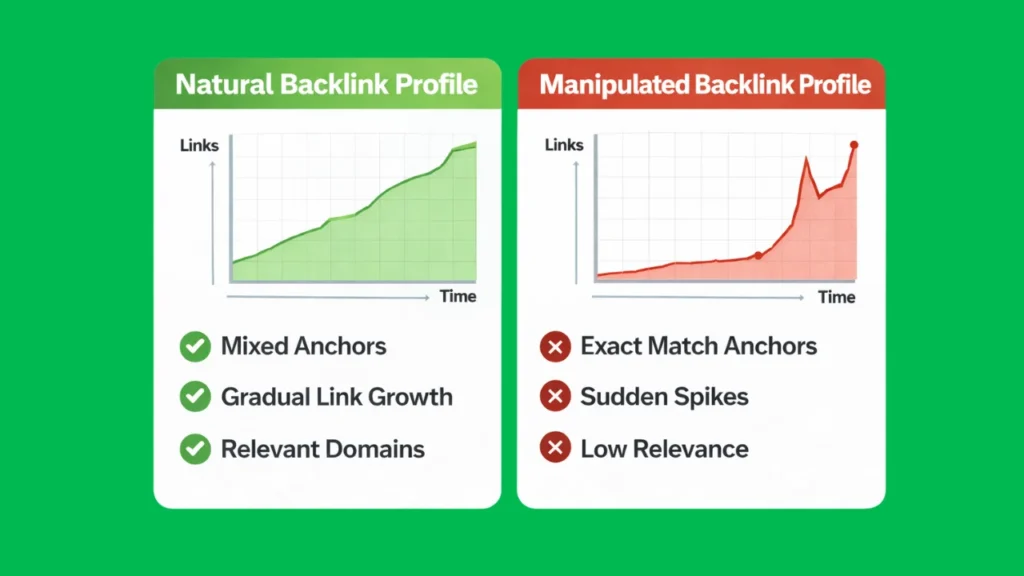
Excessive exact match anchors increase risk of over optimization. Balanced anchor ratios appear more natural.
Placement Inside Content
Search engines analyze link placement carefully. Links inside main body content pass stronger signals.
Footer, sidebar, or author bio links carry less weight. Contextual integration improves perceived relevance.
Follow and Nofollow Attributes
Dofollow links pass PageRank. Nofollow and rel sponsored links limit ranking influence.
A natural backlink profile includes both types. Over reliance on dofollow links may appear manipulated.
Link Velocity Patterns
Link velocity refers to how quickly new backlinks appear. Sudden spikes in referring domains can trigger review signals.
Gradual growth appears organic and stable. Consistent acquisition patterns reduce risk.
Outbound Link Ratios
Search engines examine outbound links on donor pages. Too many outgoing links reduce authority transfer.
Pages linking to unrelated industries raise red flags. Reasonable outbound ratios indicate editorial integrity.
Spam and Toxic Signals
Search engines detect spam patterns using multiple indicators:
- High spam score
- Thin or duplicate content
- Link farms and PBN footprints
- Shared hosting signals
- Irrelevant outbound anchors
Toxic backlinks can weaken rankings instead of strengthening them. Regular monitoring through Google Search Console, Ahrefs, and SEMrush helps detect issues early.
How to Vet a Website Before Buying Backlinks
Not every high DR site is safe. Metrics alone do not guarantee quality. You must analyze multiple signals before placing a link.
Check Domain Age and History
Older domains often carry stronger trust signals. Use WHOIS records to verify registration date.
Check historical snapshots with Wayback Machine. If a domain changed topics recently, proceed carefully. Expired domains reused for link selling carry risk.
Analyze Organic Traffic Trends
Traffic reveals whether real users visit the site. Use Ahrefs or SimilarWeb to review traffic history.
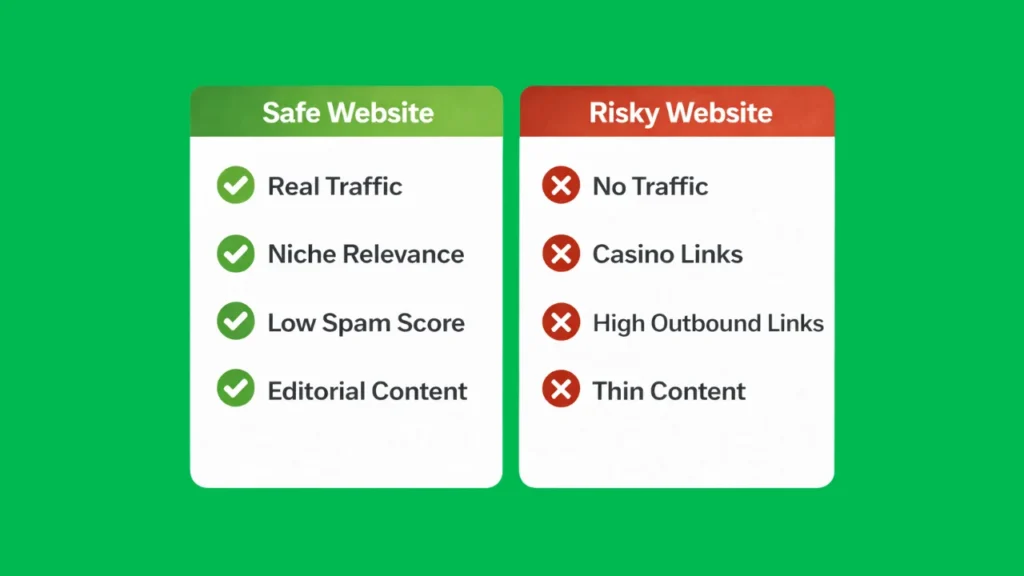
Look for steady growth, not sudden spikes or drops. Sharp declines may indicate penalties. Low traffic despite high DR is a warning sign.
Review Referring Domains
Strong sites usually have diverse referring domains. Check backlink growth trends in Ahrefs or SEMrush.
Look for natural anchor text variation. If most anchors are commercial keywords, avoid the site.
Examine Outgoing Link Patterns
Open the outgoing link anchors report. Look for unrelated industries like gambling or crypto.
Too many outbound links reduce authority value. Editorial sites maintain reasonable outbound balance.
Evaluate Content Quality
Read multiple articles on the site. Check writing depth and originality. Thin content signals low editorial standards.
Look for clear author profiles and transparency. Real sites show engagement and structured formatting.
Check Spam Score and Technical Signals
Use Moz to review spam score. Avoid domains with high spam indicators. Check whether pages are indexed in Google. If many pages are not indexed, trust may be low.
Confirm Niche Relevance
Relevance matters more than raw authority. A contextual link from a related industry site performs better. Irrelevant placements may look manipulative. Topical alignment strengthens ranking impact.
Test Communication and Transparency
Contact the site owner before purchasing. Assess response clarity and professionalism. Transparent pricing and terms reduce surprises. Avoid sellers who guarantee rankings.
Thorough vetting reduces waste and protects your backlink profile.
Safe Link Velocity and Anchor Text Strategy
Search engines analyze patterns over time. If links appear too fast, it can trigger review signals. Natural growth looks gradual and consistent.
Avoid sudden spikes in referring domains. Spread acquisition across weeks or months. A steady monthly pace reduces risk. Anchor text must also follow balanced distribution.
Healthy profiles usually include:
- Branded anchors with company name
- Partial match anchors with variations
- Generic anchors like visit site
- Naked URLs
- Limited exact match anchors
Overusing exact match anchors signals manipulation.
Balance between homepage and deep page links is important. Only linking to one commercial page looks unnatural.
Maintain a mix of:
- Dofollow links
- Nofollow links
- Sponsored links
A profile with only dofollow links looks engineered. Tier two backlinks can support authority, but use carefully. Avoid aggressive automation.
Monitor anchor ratios regularly in Ahrefs or SEMrush. Track link velocity month by month. Gradual authority growth protects rankings long term.
Competitor Backlink Analysis Framework
Before investing in new links, study the pages already ranking above you. Search engines reward authority. Competitor analysis shows how much authority you actually need. Start with a backlink audit using Ahrefs or SEMrush.
Review these elements:
- Number of referring domains
- Domain Rating of top ranking pages
- Anchor text distribution
- Link types used
- Link velocity over the last twelve months
Do not compare entire domains only. Compare the exact page ranking for your target keyword. Sometimes a page ranks with fewer links but stronger relevance.
Look at:
- Editorial placements from industry blogs
- Digital PR links from news sites
- Guest posts on niche websites
- Directory and citation presence
- Internal linking structure
Identify backlink gaps. If competitors have 120 referring domains and you have 40, you know the authority difference.
Also examine anchor text patterns. If competitors rely heavily on branded anchors, avoid aggressive exact match targeting. Find weaknesses too.
Maybe competitors lack:
- Links to supporting content
- Strong deep page authority
- Fresh referring domains
- Relevant industry publications
Use this data to build a realistic acquisition plan. Competitor research prevents random spending.
Risk Scenarios and Penalty Recovery Plan
Every link decision carries risk. Understanding possible outcomes helps you respond quickly. There are two common negative scenarios.
First is algorithmic devaluation. Rankings slowly drop. No manual action appears in Search Console. Google simply ignores certain backlinks.
Second is a manual action. You receive a notification inside Google Search Console. Traffic may decline sharply.
If performance drops suddenly, take these steps:
- Review recent link acquisition activity
- Check anchor text ratios for over optimization
- Analyze new referring domains for spam signals
- Audit outbound link patterns on donor sites
Use Ahrefs or SEMrush to identify toxic backlinks.
Look for:
- Irrelevant niche sites
- High spam score domains
- Pages with excessive outbound links
- PBN footprints or shared hosting patterns
Contact site owners to request removal of harmful links. Document communication attempts carefully.
If removal is not possible, create a disavow file. Upload it in Google Search Console.
After cleanup, submit a reconsideration request if a manual action exists. Provide clear evidence of corrective action.
Monitor rankings and referring domain growth monthly. Proactive monitoring reduces long term damage.
Backlink ROI and Financial Modeling
Spending without measuring return creates risk. Backlinks should be evaluated like any other investment. Start by estimating traffic potential.
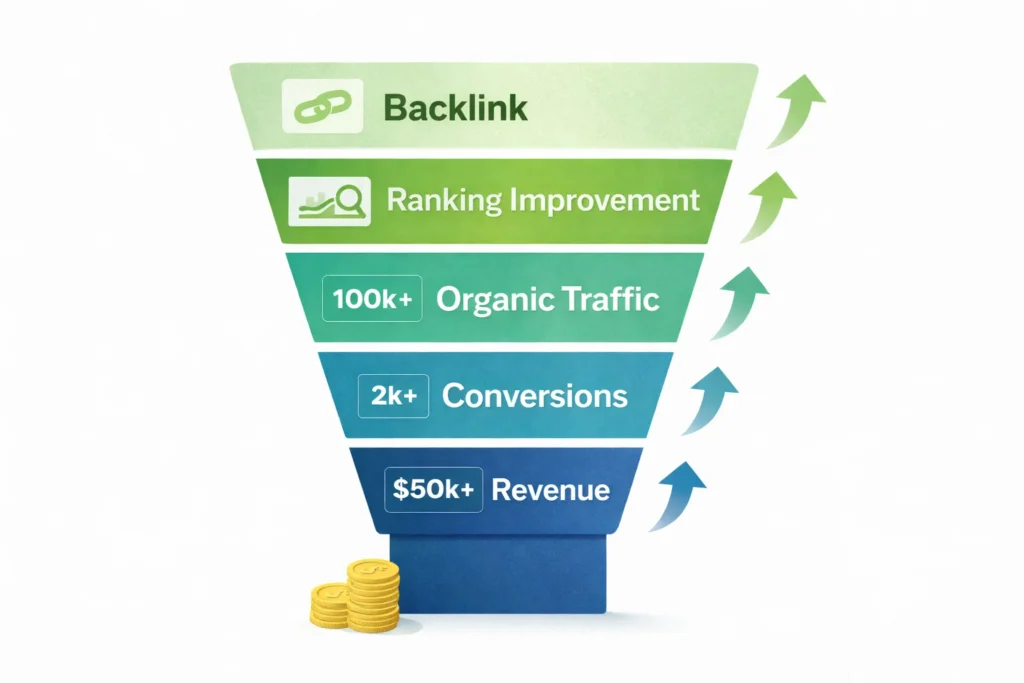
Check keyword search volume and current ranking position. Calculate how much traffic top three positions receive.
Then evaluate:
- Average click through rate for top positions
- Conversion rate from organic traffic
- Average revenue per customer
- Lifetime value if applicable
Now compare that potential revenue against link cost.
For example:
- If a backlink costs 500 dollars
- And ranking improvement generates 2000 dollars in monthly revenue
- The return justifies the investment
Also calculate cost per referring domain. High authority links cost more but may replace dozens of weak links.
Compare link building against paid ads. Paid ads stop when budget stops. Strong editorial backlinks continue passing authority.
Track metrics monthly:
- Organic traffic growth
- Keyword movement
- Referring domain increase
- Conversion changes
Use Google Search Console, Ahrefs, and analytics tools to monitor performance. ROI thinking prevents emotional decisions.
Industry Specific Buying Framework
Different industries require different risk tolerance.
Strategy must align with reputation, competition, and compliance.
For SaaS companies, authority matters heavily. Focus on:
- Editorial guest posts on software blogs
- Digital PR placements
- Industry resource pages
- Balanced anchor text strategy
Avoid aggressive exact match anchors in competitive keywords.
For law firms, reputation risk is higher. Prioritize:
- Local citations
- News features
- Bar association listings
- Niche legal publications
Avoid PBN links completely in sensitive industries.
For healthcare providers, trust signals are critical. Focus on:
- Authoritative medical sites
- Relevant health publications
- Expert contributor platforms
- Clean anchor distribution
Irrelevant placements can damage credibility.
For ecommerce brands, product visibility matters. Focus on:
- Product review sites
- Influencer collaborations
- Editorial gift guides
- Category level backlinks
Balance homepage and product page links.
For affiliate marketers, speed often drives decisions. Still maintain:
- Controlled link velocity
- Anchor variation
- Diverse link sources
- Regular backlink audits
Every niche has different competition levels.
Align link acquisition strategy with risk tolerance and long term brand value.
Industry Specific Buying Framework
Different industries require different risk tolerance. Strategy must align with reputation, competition, and compliance.
SaaS Companies
Authority matters heavily in software markets.
Focus on:
- Editorial guest posts on software blogs
- Digital PR placements
- Industry resource pages
- Balanced anchor text strategy
Avoid aggressive exact match anchors in competitive keywords.
Law Firms
Reputation risk is higher in legal industries.
Prioritize:
- Local citations
- News features
- Bar association listings
- Niche legal publications
Avoid PBN links completely in sensitive industries.
Healthcare Providers
Trust signals are critical in medical niches.
Focus on:
- Authoritative medical sites
- Relevant health publications
- Expert contributor platforms
- Clean anchor distribution
Irrelevant placements can damage credibility.
Ecommerce Brands
Product visibility drives growth.
Focus on:
- Product review sites
- Influencer collaborations
- Editorial gift guides
- Category level backlinks
Balance homepage and product page links.
Affiliate Marketers
Speed often drives affiliate strategies.
Maintain:
- Controlled link velocity
- Anchor variation
- Diverse link sources
- Regular backlink audits
Every niche has different competition levels.
Align link acquisition strategy with risk tolerance and long term brand value.
Alternatives to Buying Backlinks
Paid placements are not the only path. Organic authority can grow through strategic content.
Create linkable assets such as:
- Industry research
- Data driven studies
- Detailed guides
- Free tools or calculators
Publish original content that earns citations naturally. Guest posting without payment still works in many niches.
Pitch stories to journalists and bloggers. Build partnerships with related businesses. Leverage internal linking to distribute authority properly. A diversified strategy reduces reliance on paid links.
Common Mistakes When Buying Backlinks
Many ranking drops come from preventable errors.
Common mistakes include:
- Purchasing bulk links from freelance marketplaces
- Ignoring niche relevance
- Overusing exact match anchor text
- Focusing only on Domain Rating
- Ignoring traffic trends
- Accepting guaranteed ranking promises
- Failing to monitor backlink profile
Avoid emotional decisions. Data should guide every purchase.
Frequently Asked Questions
Conclusion
Buying backlinks remains a powerful but sensitive SEO strategy.
Success depends on relevance, authority, anchor balance, and controlled link velocity. Blind spending increases risk. Strategic analysis improves results.
Focus on quality over quantity. Vet every donor site carefully. Monitor referring domains, anchor text, and traffic trends consistently.
When handled responsibly, buying backlinks can support organic growth. When abused, it can damage rankings.
Long term authority always wins over shortcuts.