Contextual Link Building Service That Moves Rankings
Most backlinks sit in footers, author bios, or random directories. Google knows this. And Google discounts them.
Contextual links are different. They live inside the body of real, published content. The surrounding text is what Google uses to decide how much authority a link actually transfers.
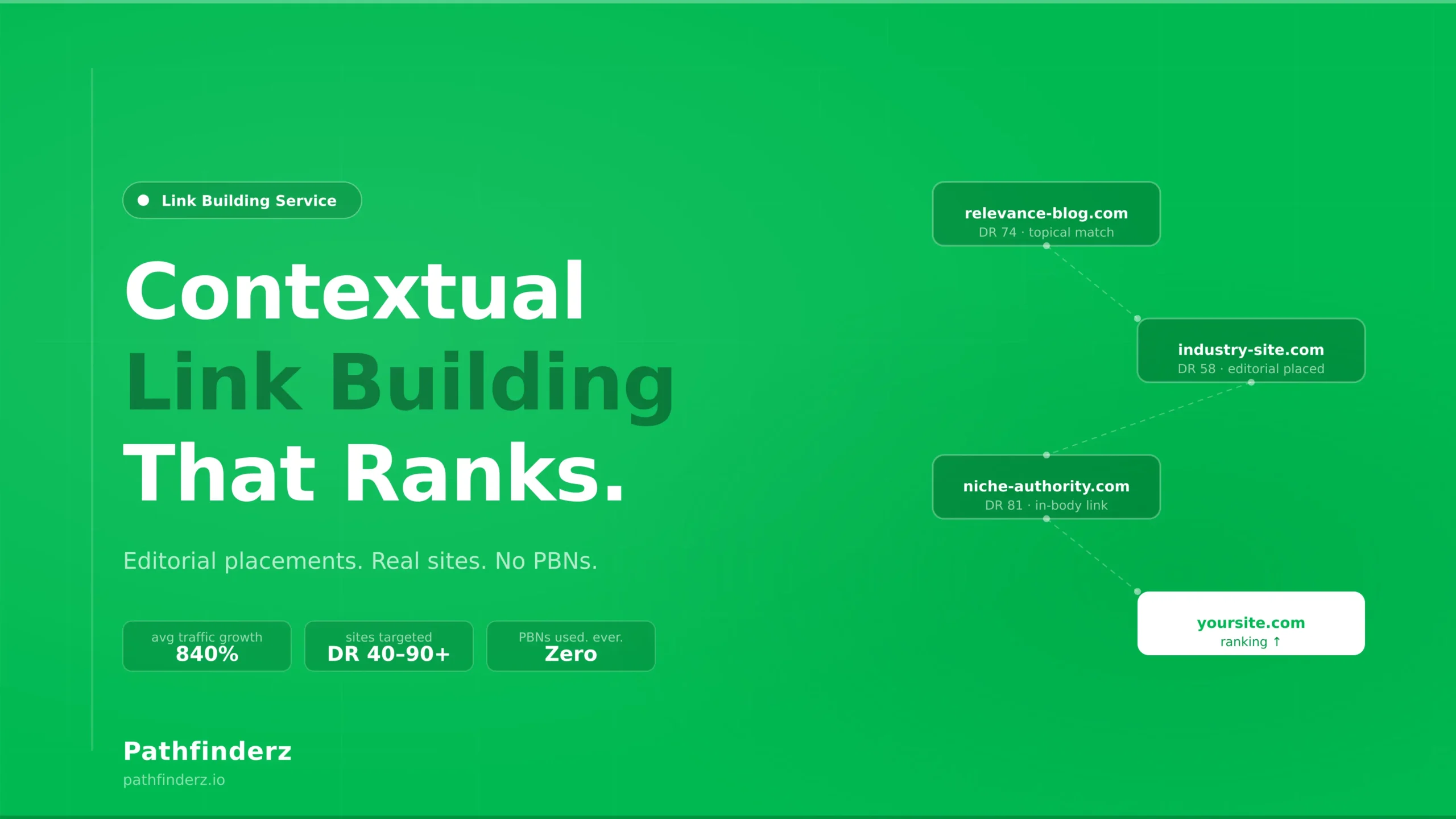
At Pathfinderz, we build contextual backlinks on manually vetted, topically relevant sites. Every placement is editorial. No PBNs. No Web 2.0 spam. No bulk packages.
What Is Contextual Link Building?
Contextual link building is the process of earning backlinks inside the main body of published content on other websites. The surrounding text has to be directly related to the page being linked.
Here is the simplest way to understand it.
A link inside a paragraph about SEO strategies that points to your link building service page is contextual. A link sitting in a blog footer that points to your homepage is not.
That placement difference is enormous. Google evaluates the topical relationship between the linking content and your destination page. The stronger that match, the more authority the link transfers.
A contextual link does these four things. It appears inside the body text of a published post. The content around it is relevant to your topic. The anchor text reflects what the linked page is about. It sits on a real website with genuine organic traffic.

A non-contextual link is something else entirely. Footer links. Sidebar widgets. Directory listings. Author bios with no topical connection to your page. Comment links. Profile backlinks.

Why Contextual Backlinks Carry More Weight Than Any Other Link Type
Not all backlinks are equal. A contextual link from a topically relevant page passes more authority than almost any other placement. Here is why.
Google built its algorithms around context
After the Penguin update, bulk link schemes stopped working. Irrelevant placements stopped working. Google shifted its entire evaluation model toward topical alignment.
SpamBrain, Google’s current AI spam detection system, goes even further. It checks the topical match between the linking page and your destination. It flags artificial link patterns at scale. Contextual links survive these filters because they look natural and because they are natural.
Relevance multiplies the authority a link passes
A link from a cybersecurity blog pointing to your SaaS tool carries more weight than the same DR link from an unrelated lifestyle site. The topical match multiplies the authority signal. Ahrefs and Moz both confirm that contextually aligned links pass more link equity than off-topic placements at the same domain rating.
Contextual links bring real referral traffic
The link appears inside content the reader is already engaged with. Click-through rates are higher. Visitors arriving from a relevant contextual placement already understand your topic. They convert at better rates than traffic from generic link sources.
They build topical authority, not just domain rating
Google has moved past pure domain authority metrics. It now evaluates topical authority. How comprehensively does your site cover a subject? Contextual links from niche-relevant sources reinforce your site’s authority within a specific topic cluster. That is what drives sustained keyword rankings.
Contextual Links vs Other Backlink Types
Here is a clear comparison so you know exactly where contextual links sit against every other link type.
Contextual backlink: placed inside an article body, high topical relevance, high SEO value, low risk.
Guest post link: also placed inside body content, medium to high relevance, high value, low to medium risk.
Niche edit or link insertion: added to existing published content, medium to high relevance, high value, low risk.
Footer or sidebar link: placed outside the content body, low relevance, low value, medium risk.
Directory link: listing page placement, low relevance, low value, low to medium risk.
PBN link: artificial network with no real audience, fake relevance, variable value, very high risk.
Profile backlink: user profile placement, no topical relevance, very low value, medium risk.
Placement and relevance decide the value of a link. Every time. Contextual backlinks score highest on both. That is why they consistently deliver the strongest SEO return.
How Pathfinderz Builds Contextual Links
We do not send mass outreach emails. We do not drop links into random blogs. Every campaign starts with strategy and ends with verified, editorial placements on sites that matter for your niche.
Step 1. Site Audit and Page Mapping
Before a single outreach email goes out, we audit your site. We map every page with ranking potential. We review your existing backlink profile. We find where contextual links will have the highest impact. Pages targeting valuable keywords with strong on-page SEO but weak referring domains get first priority.
Step 2. Prospect Research and Manual Vetting
We research publications, niche blogs, and industry sites that match your topic. Every prospect is checked manually for domain rating (typically DR 40 to 90+), organic traffic, content quality, link profile health, and niche relevance. Sites with thin content, spammy link profiles, or no topical alignment are removed before any outreach begins.
Step 3. Content Development and Angle Planning
Each placement needs a content angle that makes the link feel editorially justified. We plan that angle before outreach. Whether it is a supporting data point, a practical resource, or a topic the host site’s audience genuinely needs, the angle is built to earn the link naturally.
Step 4. Outreach and Placement
We pitch vetted publishers with a clear, transparent proposition focused on what the content adds for their readers. Every placement lands in the body of real, published content. Not a sponsored block. Not an author bio.
Step 5. Reporting and Verification
You get a placement report with live URLs, the anchor text used, DR and traffic data for each site, and the surrounding content context for every link placed. No mystery spreadsheets. Full visibility on every placement.
See exactly where your backlink profile stands.
We map your pages, audit your referring domains, and show you which links are helping and which are not.
Contextual Link Building Strategies That Work
There are several proven ways to earn contextual backlinks. The right mix depends on your niche, your existing content, and your timeline.
Guest Posting on Niche-Relevant Sites
Guest posting is the most direct way to earn editorial contextual links. You contribute an original article to a relevant site and include a contextual backlink inside the body. The key is targeting sites with real audiences and genuine editorial standards. Low-quality “write for us” directories are not guest posting. They are a waste of time and budget.
Before pitching, check the site in Ahrefs. Look at organic traffic, domain rating, and the existing link profile. If the site relies on paid-only placements with no real content standards, move on.
Broken Link Building
Find broken links on relevant websites. These are links pointing to 404 pages or dead content. Reach out to the site owner, flag the broken link, and suggest your content as a replacement. You solve a real problem for them and earn a contextual placement in return.
Use Ahrefs or SEMrush to find these opportunities. Focus on pages with many referring domains. The more sites linking to that broken URL, the more valuable the replacement becomes.
Link Insertions in Existing Content
Link insertions mean adding your link into already published, already indexed content. You do not write new content. The existing article already has authority and traffic. A contextual mention of your resource or service gets added naturally to the body text.
This is often the fastest method for earning contextual placements in competitive niches.
Digital PR and Original Research
Publishing original data or a study gives journalists and bloggers a factual resource to cite. When they cite it, you earn a contextual backlink that is genuinely editorial and unrequested. One strong data piece can earn dozens of contextual links from authoritative publications over months.
Unlinked Brand Mentions
If other sites mention your brand without linking to you, those are missed contextual link opportunities. Use Ahrefs Alerts or BuzzSumo to find unlinked mentions. Reach out and request the link. Conversion rates are high because the site already trusts you enough to mention you.
Resource Page Outreach
Many industry sites maintain curated resource pages. Getting listed on a topically relevant resource page earns a contextual link in a genuinely editorial context. These links tend to be stable and long-lasting because the resource page itself gets updated and maintained over time.
Anchor Text Strategy for Contextual Links
This is where most DIY link builders and even some agencies cause real damage.
Over-optimised anchor text is one of the fastest ways to trigger a Google penalty. SpamBrain specifically looks for unnatural anchor distributions as a spam signal. Using exact match keywords across most of your backlinks will get flagged. It is that simple.
A healthy contextual link anchor text profile looks something like this.
Branded anchors using your brand name should make up roughly 40 to 50 percent of your profile. Partial match anchors like “link building services” should cover around 20 to 25 percent. Exact match anchors like “contextual link building” should stay at 5 to 10 percent maximum. Generic anchors like “read more” or “this guide” should sit around 10 to 15 percent. URL anchors like your domain name cover another 5 to 10 percent. Natural phrase anchors like “this approach to link building” fill the rest.
Exact match anchors are not bad on their own. They need to be used sparingly within a diverse, natural-looking profile. A backlink profile where 80 percent of anchors are exact match keyword variations is a clear manipulation signal regardless of how strong the individual links are.
At Pathfinderz, anchor text is planned before every campaign. It is not chosen randomly during outreach.
What Contextual Link Building Is Not
Knowing what to avoid is just as important as knowing what works. These are the practices that get sites penalised. Some agencies still sell them under the contextual links label.
PBN links are not contextual links. Private blog networks are artificial link farms with no real audience, no editorial standard, and no content quality. SpamBrain has become highly effective at detecting PBN footprints. A link from a PBN is a liability, not an asset.
Web 2.0 spam is not link building. Posting links on Blogger or WordPress.com subdomains with thin, auto-generated content carries near-zero equity. These are trivially identified by any quality assessment.
Bulk link packages are not contextual links. Services promising hundreds of contextual links for a few dollars are selling directory submissions, profile links, and comment spam relabelled as contextual placements. Volume does not replace quality or relevance.
Paid links in non-editorial blocks are not contextual. Paying for a link is not automatically wrong. The placement still needs to be inside relevant body content on a real site with real organic traffic. Paying to appear in a link block or sponsored section with no topical content is exactly what Google’s spam policies target.
What Real Contextual Link Building Delivers
Contextual link building is not a quick fix. It is a long-term authority signal that compounds over time.
Here is what consistent, quality contextual link acquisition typically delivers.
Domain rating growth becomes visible within 60 to 120 days of sustained placements. Keyword ranking improvements for pages receiving targeted links usually appear within 6 to 12 weeks. Referral traffic from relevant audiences who actually click. Topical authority signals that support rankings across your entire keyword cluster, not just the pages directly linked. A backlink profile that passes both manual and algorithmic review without risk.
A client in the SaaS space came to us with domain rating 29, zero page one keywords, and 4,800 monthly organic visitors. After a six-month contextual link campaign across 35 placements on DR 40 to 80 sites, domain rating reached 48, page one keywords grew from 0 to 28, and organic traffic reached 45,100 visitors per month. That is 840 percent organic traffic growth from contextual link building.
Frequently Asked Questions
Ready to Build Contextual Links That Actually Rank?
Contextual link building is the most durable, highest-return link type in SEO. It only works when the placements are real, the sites are relevant, and the strategy is built around your specific pages and keywords.
That is what Pathfinderz delivers.
We audit your current backlink profile, map your pages to link opportunities, and build a campaign around topical relevance. Not just domain rating numbers.
[Get Your Free Contextual Link Building Audit]
No obligation. You get a clear picture of where your backlink profile stands, which pages need links most, and what a realistic 90-day campaign looks like for your site.
Ready to Build Links That Actually Rank?
We audit your profile, map your pages to link opportunities, and build around topical relevance. Not just DR numbers.