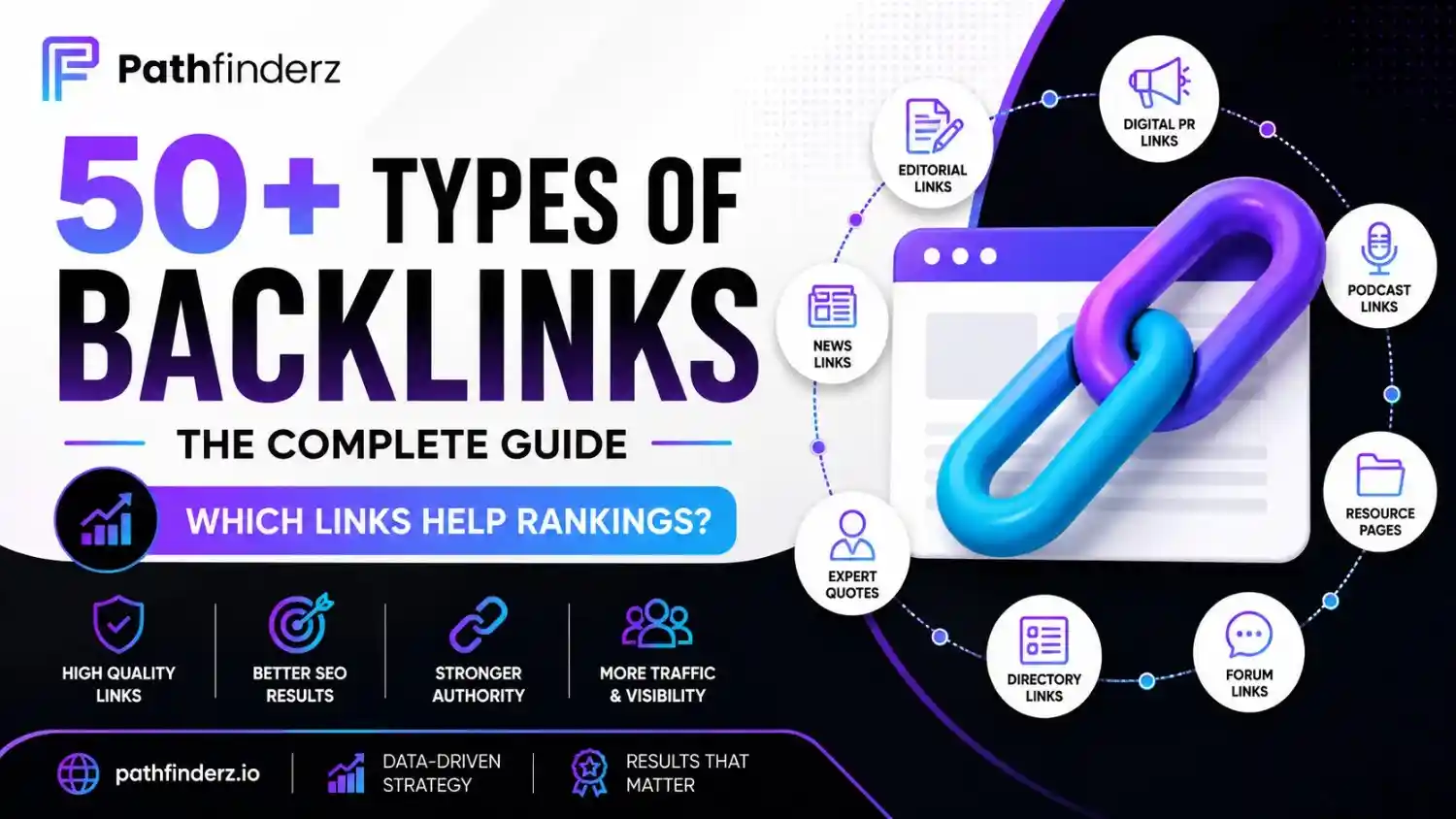
Types of Backlinks Explained, Which Links Matter for SEO in 2026
Backlinks are one of the biggest reasons some websites consistently outrank others. But not all links provide the same value. Some backlinks strengthen authority and help pages rank higher, while others contribute little or even create risks. Understanding the different types of backlinks helps you focus on links that actually support long-term SEO growth.
Most people think backlinks fall into only two categories, dofollow and nofollow. In reality, backlink types can be grouped by attributes, placement, acquisition methods, quality, and risk level. Editorial links, resource pages, podcast backlinks, and digital PR mentions all play different roles. Knowing these differences makes it easier to build a healthier backlink profile.
This guide covers the most important types of backlinks used in SEO today. You’ll learn which backlink types pass the most value, which ones are becoming outdated, and how Google evaluates links. We’ll also look at the best backlink mix for different websites, common mistakes to avoid, and which backlinks matter most in 2026.
What Are Backlinks and Why Do They Matter?
Backlinks are links from other websites pointing to your pages. They act like recommendations that help search engines understand which content deserves attention.
In SEO, backlinks remain one of the strongest ranking signals. A link from a trusted website can pass authority, send referral traffic, and help search engines discover new pages faster.
People often call backlinks inbound links, external links, or incoming links. No matter the name, the idea stays the same. Another website references your content through a clickable link.
Not every backlink has the same value. A link from a relevant website with real traffic usually carries more weight than dozens of weak links from low-quality pages.
Search engines use backlinks to evaluate trust, relevance, and popularity. When respected websites mention your content, it sends positive signals that may improve rankings over time.
What Is a Backlink?
A backlink is a hyperlink placed on one website that leads to another website. For example, if a marketing blog links to your article about SEO, that link becomes a backlink for your site.
Backlinks can appear inside articles, resource pages, images, directories, or author bios. Their location and context often influence how valuable they are.
Backlinks vs Internal Links
Internal links connect pages within the same website. Backlinks come from external websites.
For example, linking from your homepage to a blog post creates an internal link. When another website links to that same blog post, it becomes a backlink.
Both matter for SEO, but backlinks usually carry more authority because they come from outside sources.
Why Search Engines Use Backlinks
Search engines view backlinks as signals of trust. When multiple relevant websites point to the same page, it suggests the content provides value.
Google’s PageRank system was built around this idea. Although ranking algorithms have evolved, backlinks still help search engines measure authority and relevance.
This is why link building remains a core part of SEO strategies.
Examples of Good Backlinks
Here are a few examples of high-quality backlinks:
- A SaaS blog mentioning your research article.
- A news publication linking to your case study.
- A podcast website linking to your interview page.
- An industry resource page recommending your guide.
- A niche website citing your statistics or original data.
Good backlinks usually come from relevant websites, appear naturally inside content, and provide value to readers.
How Many Types of Backlinks Are There?
There is no fixed number of backlink types. Different SEO professionals classify links in different ways, which is why you’ll see lists with 10, 20, or even 50 backlink types.
The easiest way to understand backlink types is to group them by attributes, placement, acquisition method, and quality. This approach makes it easier to identify which links are worth pursuing and which ones deserve caution.
Some backlinks pass authority. Others mainly bring referral traffic or diversify your backlink profile. A few can even hurt rankings if they come from spammy sources.
That’s why focusing only on the number of backlink types misses the bigger picture. Understanding how each link works matters far more.
Types Based on Link Attributes
One way to classify backlinks is by their HTML attributes.
The four most common categories are:
- Dofollow backlinks
- Nofollow backlinks
- Sponsored backlinks
- UGC backlinks
These attributes tell search engines how a link should be treated and whether it should pass link equity.
Types Based on Placement
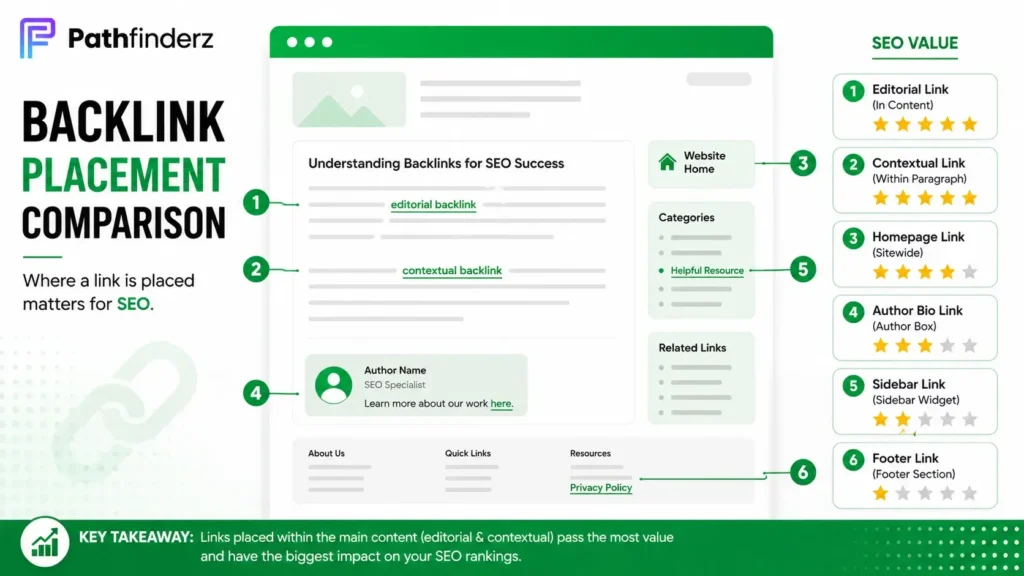
Another common classification focuses on where a link appears on a page.
Examples include:
- Editorial backlinks
- Contextual backlinks
- Homepage backlinks
- Sidebar backlinks
- Footer backlinks
- Author bio links
- Image backlinks
Link placement often affects visibility, relevance, and SEO value.
Types Based on Acquisition Method
Backlinks can also be grouped according to how they are earned or built.
Common examples include:
- Digital PR links
- HARO backlinks
- Resource page links
- Link insertions
- Broken link backlinks
- Podcast backlinks
- Directory backlinks
- Forum backlinks
- Blog comment backlinks
Each method requires a different strategy and offers varying levels of authority and risk.
Types Based on Quality and Risk
Not all backlinks deserve the same level of trust.
Most links fall into one of these categories:
- High-quality backlinks
- Relevant backlinks
- Low-quality backlinks
- Toxic backlinks
- Natural backlinks
- Manipulative backlinks
Understanding this classification helps you build a healthier backlink profile and avoid links that may trigger spam signals or manual actions.
Types of Backlinks by Link Attribute
One of the easiest ways to classify backlink types is by their link attributes. These attributes tell search engines how a link should be interpreted and whether it should pass link equity.
Most backlinks fall into four categories. Understanding the differences helps you build a more natural backlink profile and avoid common SEO mistakes.
Dofollow Backlinks
Dofollow backlinks are the most valuable type of backlinks for SEO. They pass authority from one page to another and help search engines evaluate trust and relevance.
Most editorial links, guest posts, and resource page links are dofollow by default.
Examples of dofollow backlinks include:
- Editorial mentions inside articles.
- Resource page links.
- Podcast show notes.
- Digital PR placements.
- Contextual links from relevant blogs.
A few strong dofollow backlinks from trusted websites often outperform hundreds of low-quality links.
Nofollow Backlinks
Nofollow backlinks contain a special attribute that tells search engines not to pass traditional PageRank signals.
That does not mean they are useless.
Nofollow backlinks can still:
- Drive referral traffic.
- Increase brand visibility.
- Diversify your backlink profile.
- Lead to natural editorial links later.
Common examples include:
- Social media links.
- Blog comments.
- Some news sites.
- Wikipedia citations.
- Forum discussions.
Google now treats nofollow links as hints rather than strict directives, which means they can still provide SEO value in certain situations.
Sponsored Backlinks
Sponsored backlinks are used when a link is part of advertising, sponsorships, or paid collaborations.
Google recommends using the rel="sponsored" attribute for these links.
Examples include:
- Sponsored articles.
- Paid placements.
- Affiliate partnerships.
- Brand sponsorship pages.
- Influencer collaborations.
Proper disclosure helps maintain transparency and reduces the risk of violating Google’s link spam policies.
UGC Backlinks
UGC stands for user-generated content. These links come from content created by users rather than website owners.
Examples include:
- Forum posts.
- Community discussions.
- Q&A websites.
- User reviews.
- Comment sections.
Websites can use the rel="ugc" attribute to indicate that the link was created by users.
While most UGC backlinks carry less authority, they can still generate referral traffic and contribute to a natural link profile.
Which Link Attribute Is Best?
There is no single perfect attribute.
A healthy backlink profile usually includes a mix of:
- Dofollow backlinks for authority.
- Nofollow backlinks for diversity.
- Sponsored backlinks for transparency.
- UGC backlinks for community visibility.
Search engines expect a natural mix. A backlink profile made entirely of dofollow links often looks less organic than one with varied link attributes.
Types of Backlinks by Acquisition Method
Backlinks can also be classified by how they are earned or acquired. Some methods rely on creating valuable content, while others involve outreach and relationship building.
Each approach offers different levels of authority, scalability, and difficulty.
Digital PR Backlinks
Digital PR backlinks come from news sites, magazines, and industry publications.
These links are often earned through:
- Original research.
- Surveys and statistics.
- Expert commentary.
- Newsworthy stories.
- Data studies.
Digital PR links tend to carry strong authority and can generate significant referral traffic.
HARO and Expert Quote Backlinks
Platforms like HARO, Connectively, and Qwoted connect journalists with industry experts.
When your insights are featured in articles, you often receive backlinks from trusted websites.
These links are common on:
- News publications.
- SaaS blogs.
- Business websites.
- Marketing magazines.
Expert quote links are difficult to scale, but they provide strong trust signals.
Resource Page Backlinks
Resource pages collect useful tools, guides, and references.
Website owners often link to content that helps their readers solve a problem.
Examples include:
- Best tools pages.
- Helpful resources sections.
- Industry directories.
- Educational references.
Resource page backlinks work best when your content genuinely adds value.
Unlinked Brand Mention Backlinks
Sometimes websites mention your company without linking to it.
A simple outreach email can turn those mentions into backlinks.
These opportunities often come from:
- Blog articles.
- Product roundups.
- News stories.
- Reviews.
Converting existing mentions is usually easier than acquiring completely new links.
Broken Link Backlinks
Broken link building involves finding dead pages and suggesting your content as a replacement.
This method helps website owners fix errors while helping you earn backlinks.
Common targets include:
- Resource pages.
- Statistics pages.
- Guides.
- Educational articles.
Broken link opportunities require research but can produce highly relevant backlinks.
Link Insertions
Link insertions, also called niche edits, involve placing links into existing content.
Unlike guest posts, these links appear on pages that already have authority and rankings.
Link insertions are commonly used for:
- SaaS websites.
- Ecommerce stores.
- Service businesses.
- Affiliate sites.
Quality matters more than quantity. Relevant pages with real traffic provide the best results.
Podcast Backlinks
Podcast backlinks come from show notes and episode pages.
They often include:
- Guest profiles.
- Website links.
- Social media profiles.
- Resource references.
Podcasts can deliver backlinks, referral traffic, and brand visibility at the same time.
Webinar Backlinks
Webinars create opportunities for links from registration pages, event pages, and recordings.
These backlinks frequently come from:
- Associations.
- Industry communities.
- Educational websites.
- Business events.
Webinar links are often overlooked, despite their strong relevance.
Business Directory Backlinks
Business directories help establish trust and local relevance.
Examples include:
- Google Business Profile.
- Yelp.
- Clutch.
- Industry-specific directories.
High-quality directories can support local SEO, while low-quality directories should be avoided.
Social Media Backlinks
Social platforms mostly provide nofollow links, but they still help distribute content.
Popular examples include:
- LinkedIn.
- Facebook.
- X.
- Reddit.
- YouTube.
Social backlinks support brand visibility and may attract editorial backlinks later.
Forum Backlinks
Forums allow businesses and individuals to participate in discussions and share resources.
Common platforms include:
- Reddit.
- Quora.
- Industry communities.
- Technical forums.
Forum backlinks work best when they provide genuine value instead of promotional spam.
Blog Comment Backlinks
Blog comments are one of the oldest backlink methods.
Most comment links are nofollow, but they can still bring:
- Referral traffic.
- Brand awareness.
- Community engagement.
Mass blog commenting no longer provides meaningful ranking benefits.
PDF and Document Backlinks
Documents can contain clickable links that point back to your website.
Examples include:
- White papers.
- Case studies.
- Presentations.
- Research reports.
- Downloadable guides.
These backlinks rarely drive major authority, but they help expand your online footprint.
Which Acquisition Method Works Best?
There is no single winner.
Digital PR, editorial outreach, expert quotes, and resource pages generally provide the highest SEO value.
Directories, forums, and document links play supporting roles by creating a more diverse backlink profile.
The best strategy is to combine several acquisition methods instead of relying on one source alone.
Types of Backlinks by Quality
Not every backlink deserves the same level of trust. Search engines evaluate backlinks based on relevance, authority, traffic, and overall quality.
A single backlink from a trusted website can outperform dozens of weak links.
Understanding quality helps you focus on backlinks that actually improve rankings.
High Authority Backlinks
High authority backlinks come from websites with strong reputations and established backlink profiles.
Examples include:
- Industry publications.
- News websites.
- Popular blogs.
- Educational institutions.
- Government websites.
Authority alone is not enough. Relevance also matters.
A backlink from a respected website in your niche usually provides more value than an unrelated authority site.
Topically Relevant Backlinks
Topical relevance is one of the strongest ranking factors.
Search engines prefer links from websites that cover similar subjects.
For example:
- A SaaS company benefits from links on marketing and technology websites.
- A law firm benefits from legal blogs and business directories.
- A healthcare website benefits from medical publications.
Relevant backlinks help search engines understand your expertise and subject matter.
Real Traffic Backlinks
Some backlinks send actual visitors, while others exist only for SEO purposes.
Real traffic backlinks often come from:
- Popular blogs.
- News sites.
- Podcasts.
- Resource pages.
- Community websites.
Referral traffic is a strong signal because it shows people are clicking and engaging with the link.
Local Backlinks
Local backlinks help businesses improve visibility in specific locations.
Common sources include:
- Chamber of commerce websites.
- Local newspapers.
- Community organizations.
- Local directories.
- Event sponsorships.
These backlinks are especially valuable for local SEO campaigns.
News Backlinks
News backlinks come from magazines, newspapers, and media websites.
Examples include:
- Press coverage.
- Interviews.
- Research reports.
- Industry announcements.
News backlinks can increase authority and strengthen brand recognition.
They also attract natural backlinks from other publishers.
Educational Backlinks
Educational backlinks come from schools, universities, and research institutions.
These links often appear on:
- Resource pages.
- Scholarship pages.
- Research papers.
- Academic projects.
Many people overvalue .edu links. Their real value depends on relevance and page quality, not the domain extension itself.
Government Backlinks
Government backlinks come from official organizations and public institutions.
Examples include:
- Local government websites.
- Public programs.
- Business directories.
- Community initiatives.
Like educational backlinks, relevance matters more than simply getting a .gov link.
Natural Backlinks
Natural backlinks are earned without directly requesting them.
They happen when people voluntarily reference your content.
Common reasons include:
- Original research.
- Statistics pages.
- Free tools.
- Case studies.
- Helpful guides.
Natural backlinks are among the safest and most sustainable types of backlinks.
Toxic Backlinks
Toxic backlinks can harm your backlink profile and create spam signals.
Examples include:
- Link farms.
- Automated backlinks.
- Spam directories.
- Hacked websites.
- Irrelevant foreign sites.
Not every low-quality backlink causes problems, but patterns of manipulative links can lead to ranking losses or manual actions.
Which Quality Signals Matter Most?
Search engines evaluate backlinks using several factors:
- Relevance.
- Authority.
- Placement.
- Anchor text.
- Indexability.
- Referral traffic.
- Content quality.
- Link diversity.
The best backlinks combine multiple quality signals instead of relying on a single metric like Domain Rating or Domain Authority.
Types of Backlinks by Risk Level
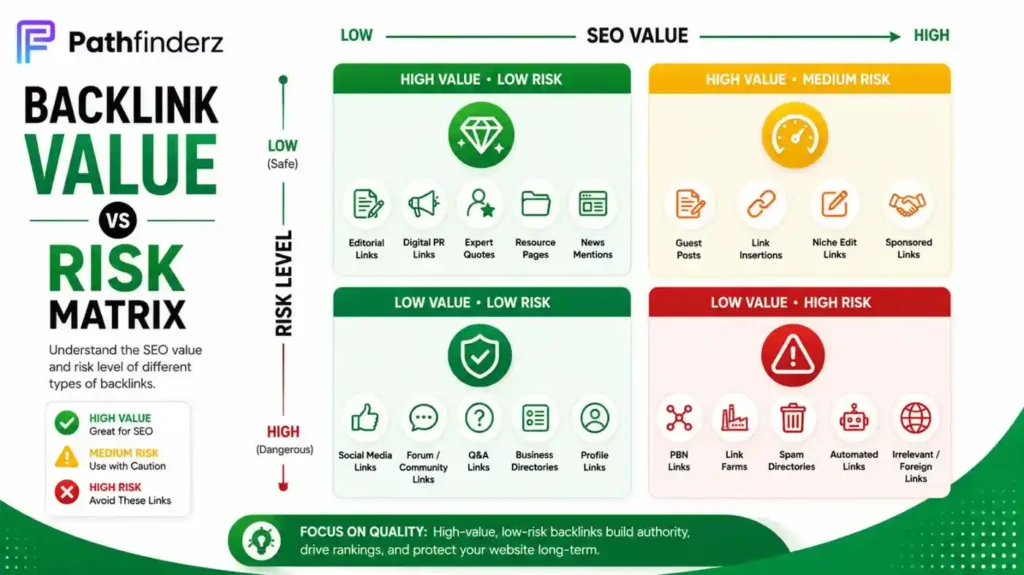
Not every backlink carries the same level of risk. Some links align with Google’s guidelines, while others can trigger spam signals or manual actions.
Understanding risk levels helps you build a healthier backlink profile and avoid costly mistakes.
Low Risk Backlinks
Low risk backlinks are natural, relevant, and difficult to manipulate.
These links usually come from websites with real traffic and quality content.
Examples include:
- Editorial backlinks.
- Digital PR links.
- Expert quote backlinks.
- Resource page links.
- Podcast backlinks.
- Unlinked brand mentions.
- News backlinks.
These backlinks support long-term SEO growth and rarely create problems.
Medium Risk Backlinks
Medium risk backlinks can still work well when used carefully.
Problems usually appear when quantity becomes more important than quality.
Examples include:
- Guest post backlinks.
- Link insertions.
- Business directories.
- Forum backlinks.
- Author bio links.
- Web 2.0 links.
These links should come from relevant websites with genuine audiences. Aggressive campaigns often increase risk.
High Risk Backlinks
High risk backlinks may provide short-term gains, but they can attract unwanted attention from search engines.
Examples include:
- Excessive reciprocal links.
- Sitewide footer links.
- Sidebar links across hundreds of pages.
- Large-scale blog comments.
- Automated profile links.
- Mass directory submissions.
Search engines are much better at detecting unnatural patterns than they were a few years ago.
Dangerous Backlinks
Dangerous backlinks offer little value and create serious risks.
Examples include:
- Link farms.
- Private blog networks.
- Spam directories.
- Hacked websites.
- Expired domains used for manipulation.
- Automated link building software.
These links can damage trust and contribute to manual actions or algorithmic penalties.
White Hat, Gray Hat, and Black Hat Backlinks
Most backlink strategies fall into one of three categories.
White Hat Backlinks
White hat backlinks focus on earning links through value and relationships.
Common examples include:
- Editorial links.
- Digital PR.
- Expert quotes.
- Resource pages.
- Original research.
These links are the safest option for long-term rankings.
Gray Hat Backlinks
Gray hat backlinks operate in areas that are not always clearly defined.
Examples include:
- Guest posts.
- Link insertions.
- Selective exchanges.
- Sponsored collaborations.
Many websites use these tactics, but quality and moderation are essential.
Black Hat Backlinks
Black hat backlinks are designed to manipulate rankings.
Examples include:
- PBNs.
- Link farms.
- Automated links.
- Spam comments.
- Hidden links.
These tactics may work temporarily, but they carry the highest risk.
How to Spot Risky Backlinks
Several warning signs indicate that a backlink may be harmful.
Watch for:
- Irrelevant websites.
- Thin content.
- Excessive outbound links.
- Zero organic traffic.
- Overoptimized anchor text.
- Sitewide placements.
- Large numbers of identical links.
A backlink should look natural and provide value to readers. If a link exists only for SEO purposes, it deserves closer inspection.
Should You Avoid Every Risky Link?
Not necessarily.
A few low-quality backlinks are normal. Most websites naturally attract mixed links over time.
Problems usually arise when manipulative patterns dominate the backlink profile.
Building diverse backlinks from trusted and relevant sources remains the safest approach for sustainable rankings.
Which Backlink Types Pass the Most SEO Value?
Not all backlinks contribute equally to rankings. Some links pass stronger authority, while others mainly provide referral traffic or brand exposure.
Search engines evaluate several signals before assigning value to a backlink.
Links With High Link Equity
Links from trusted websites often pass the most link equity.
Examples include:
- Editorial backlinks.
- Digital PR placements.
- Resource page links.
- Industry publications.
- News websites.
These links help strengthen authority and improve rankings over time.
A few strong backlinks can outperform hundreds of weak ones.
Links With Strong Topical Relevance
Relevance matters as much as authority.
A backlink from a website covering similar topics sends stronger signals to search engines.
For example:
- A SaaS company benefits from marketing and technology blogs.
- A law firm benefits from legal publications.
- An ecommerce store benefits from retail and shopping websites.
Topically relevant backlinks help establish expertise within a niche.
Links With Real Organic Traffic
Backlinks that send visitors provide additional value.
Search engines recognize that users interact with these links.
Examples include:
- Popular blogs.
- Podcast show notes.
- Industry communities.
- Resource pages.
- News articles.
Referral traffic often leads to more mentions and natural backlinks.
Links With Natural Anchor Text
Anchor text helps search engines understand the linked page.
Natural anchor text patterns usually include:
- Branded anchors.
- Partial match anchors.
- Generic anchors.
- Naked URLs.
Overusing exact match anchors can create spam signals and increase risk.
Links From Trusted Referring Domains
The quality of the referring domain matters more than the number of backlinks.
Trusted domains usually have:
- Strong backlink profiles.
- Real traffic.
- Relevant content.
- Active audiences.
- Good indexation.
One backlink from a trusted website often provides more value than dozens from weak domains.
Links Positioned Inside Content
Placement also influences SEO value.
Contextual links inside the main content generally perform better than links placed elsewhere.
The strongest placements include:
- Editorial mentions.
- Contextual backlinks.
- Resource page links.
- Homepage links.
- Author bio links.
- Sidebar links.
- Footer links.
Links surrounded by relevant text provide stronger context and trust signals.
Links That Attract More Backlinks
Some backlinks create secondary benefits.
News mentions, original research, and digital PR campaigns often attract additional backlinks naturally.
These links can compound their value because other publishers reference the same source.
Examples include:
- Data studies.
- Industry reports.
- Surveys.
- Free tools.
- Statistics pages.
This effect helps build authority faster than isolated links.
Backlink Types Ranked by SEO Value
| Backlink Type | SEO Value | Difficulty |
|---|---|---|
| Editorial Backlinks | Very High | High |
| Digital PR Links | Very High | High |
| Expert Quote Links | High | Medium |
| Resource Page Links | High | Medium |
| Podcast Backlinks | High | Medium |
| Contextual Backlinks | High | Medium |
| Homepage Backlinks | Medium | Medium |
| Directory Backlinks | Medium | Low |
| Social Media Backlinks | Low | Low |
| Forum Backlinks | Low | Low |
| Blog Comment Backlinks | Low | Low |
Is There One Best Type of Backlink?
No single backlink type wins every time.
The most effective backlink profiles combine:
- High authority backlinks.
- Relevant backlinks.
- Real traffic backlinks.
- Natural anchor text.
- Diverse referring domains.
Search engines reward natural link profiles built through multiple sources rather than one repetitive strategy.
What Makes a Quality Backlink?
A quality backlink does more than point to your website. It helps search engines understand that your content deserves trust and visibility.
Many people focus only on Domain Rating or Domain Authority. In reality, several factors determine whether a backlink provides SEO value.
Relevance
Relevance is one of the strongest quality signals.
A backlink from a website covering similar topics usually carries more weight than an unrelated authority site.
For example:
- A SaaS company benefits from technology blogs.
- A healthcare website benefits from medical publications.
- An ecommerce store benefits from retail websites.
Search engines use topical relevance to understand expertise.
Authority
Authority reflects the trust and reputation of the linking website.
Trusted domains often have:
- Strong backlink profiles.
- Consistent organic traffic.
- High-quality content.
- Real audiences.
Authority matters, but relevance should always come first.
Placement
Where a link appears on a page affects its value.
Contextual backlinks inside the main content generally perform best.
Common placements include:
- Editorial mentions.
- Contextual links.
- Resource page links.
- Homepage links.
- Author bios.
- Sidebar links.
- Footer links.
Links hidden in sidebars or footers usually pass less value.
Anchor Text
Anchor text provides context about the destination page.
Healthy backlink profiles contain a mix of:
- Branded anchors.
- Partial match anchors.
- Generic anchors.
- Naked URLs.
- Occasional exact match anchors.
Too many keyword-rich anchors can create spam signals.
Indexability
A backlink cannot help much if search engines never discover it.
Quality backlinks usually come from pages that are:
- Indexed by Google.
- Regularly crawled.
- Receiving traffic.
- Updated over time.
Links on orphan pages often provide little benefit.
Referral Traffic
Good backlinks send visitors, not just SEO signals.
Referral traffic indicates that people are clicking and engaging with the link.
Backlinks with real traffic often come from:
- Popular blogs.
- Industry communities.
- News websites.
- Podcasts.
- Resource pages.
Traffic and rankings often reinforce each other.
Content Quality
The quality of the surrounding content matters. Pages with useful information tend to provide stronger trust signals.
Warning signs include:
- Thin content.
- Keyword stuffing.
- Excessive advertisements.
- Poor readability.
- Hundreds of outbound links.
Quality content creates a better environment for backlinks.
Link Diversity
A natural backlink profile contains links from different sources.
Examples include:
- Editorial backlinks.
- Digital PR links.
- Resource pages.
- Podcasts.
- Directories.
- Social platforms.
- Communities.
Relying on one source makes a backlink profile look less natural.
Trust Signals
Search engines evaluate trust in several ways.
Strong trust signals include:
- Real traffic.
- Relevant content.
- Established brands.
- Editorial standards.
- Natural anchor text.
- Active websites.
These signals often matter more than a single metric.
What a Good Backlink Looks Like
A high-quality backlink usually checks several boxes:
- Comes from a relevant website.
- Appears naturally inside content.
- Uses natural anchor text.
- Sends referral traffic.
- Lives on an indexed page.
- Comes from a trusted domain.
- Provides value to readers.
What a Bad Backlink Looks Like
Low-quality backlinks often share common traits.
Examples include:
- Spam directories.
- Link farms.
- Auto-generated pages.
- Irrelevant websites.
- Overoptimized anchor text.
- Sitewide placements.
- Pages with hundreds of outgoing links.
Quality Beats Quantity Every Time
Ten high-quality backlinks from trusted websites can outperform hundreds of weak links. Search engines reward authority, relevance, and trust far more than raw numbers.
That is why successful link building focuses on earning better backlinks rather than collecting more backlinks.
Best Types of Backlinks for Different Websites
The best type of backlinks depends on your business model and goals. A strategy that works for a SaaS company may not work for a local business or an ecommerce store.
Understanding which backlinks fit your website helps you invest time and resources more effectively.
SaaS Websites
SaaS companies compete in crowded markets where authority and trust matter.
The most effective backlink types for SaaS websites include:
- Editorial backlinks.
- Digital PR links.
- Expert quote backlinks.
- Podcast backlinks.
- Resource page links.
- Data study links.
- Comparison page mentions.
These backlinks help improve rankings while building brand awareness.
Ecommerce Stores
Ecommerce websites benefit from links that support products and category pages.
Strong backlink sources include:
- Product roundups.
- Gift guides.
- Review websites.
- Influencer collaborations.
- News publications.
- Resource pages.
Original studies and buying guides also attract natural backlinks over time.
Local Businesses
Local SEO relies heavily on trust and geographic relevance.
Useful backlink types include:
- Chamber of commerce websites.
- Local newspapers.
- Community organizations.
- Event sponsorships.
- Local directories.
- Business associations.
These backlinks help strengthen local search visibility.
Affiliate Websites
Affiliate sites need authority and topical relevance.
Popular backlink types include:
- Editorial links.
- Resource pages.
- Statistics pages.
- Expert roundups.
- Industry blogs.
- Podcast mentions.
High-quality content attracts backlinks naturally and supports rankings.
Blogs and Publishers
Blogs often perform best when they focus on earning links through content.
Examples include:
- Original research.
- Surveys.
- Statistics pages.
- Infographics.
- Guest appearances.
- News mentions.
Useful content creates opportunities for natural backlinks.
B2B Companies
B2B websites benefit from authority and relationship-based links.
Effective options include:
- Industry publications.
- Case studies.
- Podcast interviews.
- Expert quotes.
- Digital PR campaigns.
- Webinar partnerships.
These links help establish credibility and generate qualified traffic.
Startups
Startups often need visibility and trust quickly.
Good backlink opportunities include:
- Founder interviews.
- Startup directories.
- Product launch websites.
- Podcast appearances.
- News coverage.
- Expert contributions.
Strong brand mentions can create momentum during early growth.
Service Businesses
Service-based companies need links that support authority and local visibility.
Common sources include:
- Industry directories.
- Professional associations.
- Resource pages.
- Local news sites.
- Partner websites.
- Educational content.
Relevant backlinks usually outperform high-volume campaigns.
Which Backlinks Work Across Almost Every Industry?
Some backlink types deliver value regardless of niche.
These include:
- Editorial backlinks.
- Digital PR links.
- Resource page backlinks.
- Expert quote links.
- Podcast backlinks.
- Unlinked brand mentions.
- News backlinks.
These links combine authority, relevance, and trust, making them valuable for most websites.
Avoid Copying Someone Else’s Strategy
Every website has different goals and competition levels.
The best backlink profile is not built around one tactic. It combines several backlink types that match your industry, audience, and growth stage.
A balanced approach usually delivers stronger and more sustainable results.
Best Types of Backlinks for Different Goals
Not every backlink serves the same purpose. Some links help build authority, while others drive traffic or strengthen local visibility.
Choosing backlink types based on your goals leads to better results and a healthier backlink profile.
Building Authority
Authority backlinks help search engines trust your website.
The strongest options include:
- Editorial backlinks.
- Digital PR links.
- Expert quote backlinks.
- Industry publications.
- News mentions.
- Research citations.
These backlinks improve credibility and support long-term rankings.
Increasing Organic Traffic
Some backlinks provide both rankings and visitors.
Strong choices include:
- Resource page links.
- Popular blogs.
- Podcast show notes.
- News websites.
- Industry communities.
- Comparison articles.
Referral traffic often leads to additional natural backlinks.
Improving Local Rankings
Local businesses benefit from backlinks with geographic relevance.
Useful sources include:
- Local directories.
- Chamber of commerce websites.
- Community organizations.
- Local newspapers.
- Event sponsorships.
- Business associations.
These links help improve local SEO and trust.
Growing Brand Visibility
Brand awareness matters as much as rankings.
Effective backlink types include:
- Podcast interviews.
- Expert roundups.
- Webinar partnerships.
- News coverage.
- Social communities.
- Industry events.
Mentions across multiple platforms strengthen brand recognition.
Supporting Product Pages
Product pages are difficult to rank with backlinks alone.
Supporting content often attracts links more naturally.
Useful backlink sources include:
- Buying guides.
- Product roundups.
- Review websites.
- Comparison pages.
- Resource pages.
- Case studies.
These links can pass authority to important commercial pages.
Generating Leads
Some backlinks attract highly targeted visitors.
Examples include:
- Industry blogs.
- Podcast appearances.
- Webinar pages.
- Professional associations.
- Niche directories.
These backlinks often bring visitors with strong purchase intent.
Building Trust
Trust signals influence both users and search engines.
The best sources include:
- News websites.
- Educational institutions.
- Industry publications.
- Government organizations.
- Professional communities.
Trusted mentions help establish expertise and authority.
Acquiring Natural Backlinks
Certain assets attract backlinks without constant outreach.
Examples include:
- Original research.
- Statistics pages.
- Free tools.
- Templates.
- Industry reports.
- Case studies.
These assets continue generating backlinks over time.
Improving AI Search Visibility
Brand mentions are becoming increasingly important.
Strong signals come from:
- Editorial publications.
- Podcasts.
- Expert quotes.
- Industry communities.
- News websites.
- Resource pages.
Mentions across trusted sources help strengthen entity recognition and online authority.
Matching Backlink Types With Goals
Different goals require different link strategies.
| Goal | Best Backlink Types |
|---|---|
| Authority | Editorial, Digital PR, News Links |
| Traffic | Blogs, Resource Pages, Podcasts |
| Local SEO | Directories, Newspapers, Associations |
| Brand Awareness | Podcasts, Webinars, Communities |
| Leads | Industry Sites, Associations, Blogs |
| Product Rankings | Roundups, Reviews, Comparison Pages |
| Long-Term Growth | Research, Statistics, Free Tools |
The most successful websites build backlinks with clear objectives instead of chasing every opportunity.
Best Backlink Mix for a Natural Link Profile
Search engines expect websites to earn backlinks from different sources. A profile built entirely on one type of link can look unnatural, even if those links come from quality websites.
Link diversity helps create stronger trust signals and reduces risk.
A balanced backlink profile usually contains a mix of authority, relevance, and traffic-generating links.
Recommended Mix for New Websites
New websites should focus on building trust before scaling link acquisition.
A healthy mix may include:
- 40% editorial and contextual backlinks.
- 20% resource page links.
- 15% podcast and expert quote links.
- 10% directory and citation links.
- 10% social and community mentions.
- 5% miscellaneous backlinks.
New sites should prioritize quality over volume.
Recommended Mix for Established Websites
Established websites can pursue a broader range of opportunities.
An example mix includes:
- 45% editorial backlinks.
- 20% digital PR and news links.
- 15% resource pages.
- 10% podcast and webinar links.
- 5% directory links.
- 5% social mentions.
Strong websites usually earn backlinks naturally while continuing outreach campaigns.
Recommended Mix for Competitive Niches
Competitive industries require stronger authority signals.
Examples include SaaS, finance, healthcare, and legal websites.
A balanced profile may include:
- 50% editorial backlinks.
- 20% digital PR links.
- 15% expert quote backlinks.
- 10% resource pages.
- 5% supporting links.
These industries benefit more from quality than quantity.
Recommended Mix for Local Businesses
Local websites need both authority and geographic relevance.
Common sources include:
- Local newspapers.
- Chamber of commerce websites.
- Community organizations.
- Industry directories.
- Resource pages.
- Business associations.
A combination of local and authority backlinks often produces the best results.
Recommended Mix for Ecommerce Websites
Ecommerce websites benefit from links that support category and product pages.
Strong sources include:
- Product roundups.
- Buying guides.
- Review websites.
- Resource pages.
- News mentions.
- Editorial backlinks.
Supporting informational content usually attracts links more naturally than product pages.
Common Link Diversity Mistakes
Many websites make the mistake of relying on one source.
Common problems include:
- Building only guest posts.
- Using excessive exact match anchors.
- Ignoring nofollow backlinks.
- Acquiring links too quickly.
- Focusing only on Domain Rating.
- Chasing large quantities of links.
A natural profile contains a variety of link sources and anchor text patterns.
Anchor Text Distribution Matters
Link diversity is not only about backlink sources.
Healthy profiles typically include:
- Branded anchors.
- Generic anchors.
- Naked URLs.
- Partial match anchors.
- Limited exact match anchors.
Natural anchor variation helps reduce spam signals.
Dofollow and Nofollow Balance
Most websites earn a mixture of dofollow and nofollow backlinks.
Examples of nofollow sources include:
- Social media platforms.
- Forums.
- Blog comments.
- Community websites.
A profile made entirely of dofollow backlinks can appear unnatural.
Quality Beats Percentages
There is no perfect ratio that works for every website.
The right backlink mix depends on:
- Industry competition.
- Website age.
- Current authority.
- Content quality.
- Business goals.
Search engines reward websites that earn backlinks naturally from different sources rather than repeating the same strategy.
What Does a Healthy Backlink Profile Look Like?
A strong backlink profile usually contains:
- Editorial backlinks.
- Contextual links.
- Resource page links.
- Podcast backlinks.
- News mentions.
- Expert quotes.
- Community discussions.
- Branded anchor text.
- Both dofollow and nofollow links.
Diversity, relevance, and trust matter far more than chasing a specific percentage.
Anchor Text Types and Their Relationship With Backlinks
Anchor text is the clickable text used in a hyperlink. It helps search engines understand what the linked page is about and provides context for users.
Anchor text and backlink types work together. Even a high-quality backlink can become risky if the anchor text profile looks unnatural.
A healthy backlink profile contains different anchor text variations instead of repeating the same keywords.
Branded Anchors
Branded anchors use your company or website name.
Examples include:
- Pathfinderz
- Pathfinderz.io
- Visit Pathfinderz
Branded anchors are the safest and most natural anchor text type.
Most strong backlink profiles contain a large percentage of branded anchors.
Partial Match Anchors
Partial match anchors contain part of the target keyword along with additional words.
Examples include:
- Types of backlinks guide
- Learn about backlink types
- SEO backlink types explained
Partial match anchors help reinforce relevance without appearing manipulative.
Generic Anchors
Generic anchors do not contain keywords.
Examples include:
- Read more
- Learn more
- Click here
- This guide
- Visit this page
These anchors create diversity and mimic natural linking behavior.
Naked URL Anchors
Naked URL anchors use the actual web address.
Examples include:
Many citations, forums, and references naturally use naked URLs.
These anchors help create a balanced backlink profile.
Exact Match Anchors
Exact match anchors use the primary keyword directly.
Examples include:
- Types of backlinks
- Backlink types
- Best types of backlinks
Exact match anchors can improve relevance, but excessive use may trigger spam signals.
Moderation is important.
Image Anchors
When an image contains a hyperlink, the alt text often acts like anchor text.
Examples include:
- Infographic alt text.
- Logo links.
- Charts and graphics.
Image backlinks contribute additional diversity to the backlink profile.
Compound Anchors
Compound anchors combine branded terms with keywords.
Examples include:
- Pathfinderz backlink types guide
- Pathfinderz SEO resources
These anchors provide context while keeping the profile natural.
Which Anchor Text Type Is Safest?
Branded anchors are generally the safest.
Most natural backlink profiles are dominated by:
- Branded anchors.
- Generic anchors.
- Naked URLs.
- Partial match anchors.
Exact match anchors usually represent a smaller percentage.
When Anchor Text Becomes Risky
Anchor text becomes risky when patterns appear unnatural.
Common warning signs include:
- Repeating the same keyword.
- Excessive exact match anchors.
- Keyword stuffing.
- Identical anchors across many domains.
- Links from irrelevant websites.
Search engines look for natural variation rather than perfect optimization.
Anchor Text Distribution Example
A healthy backlink profile often includes:
| Anchor Type | Typical Usage |
|---|---|
| Branded Anchors | High |
| Generic Anchors | Medium |
| Naked URLs | Medium |
| Partial Match Anchors | Medium |
| Exact Match Anchors | Low |
There is no perfect formula. Every website develops differently over time.
Matching Anchor Types With Backlink Types
Different backlink types naturally produce different anchors.
| Backlink Type | Common Anchor Style |
|---|---|
| Editorial Links | Branded, Partial Match |
| News Links | Brand Name |
| Podcast Links | Branded, Naked URL |
| Resource Pages | Partial Match |
| Directory Links | Brand Name |
| Forum Links | Naked URL |
| Social Media Links | Brand Name |
| Blog Comments | Generic Anchors |
Natural anchor text diversity helps create stronger trust signals and supports long-term rankings.
How Google Evaluates Different Types of Backlinks
Google does not treat every backlink equally. Search engines evaluate several signals to determine whether a link deserves trust and how much SEO value it should pass.
A backlink from a relevant page with real traffic often carries more weight than dozens of links from weak websites.
Understanding these signals helps you focus on backlinks that actually matter.
Relevance Signals
Topical relevance is one of the strongest ranking factors.
Google looks at:
- The topic of the linking website.
- The content surrounding the link.
- Related entities and keywords.
- User intent.
- The relationship between both pages.
For example, a backlink from a marketing blog makes more sense for an SEO agency than a backlink from an unrelated cooking website.
Trust Signals
Google wants links that reflect genuine recommendations.
Strong trust signals include:
- Editorial mentions.
- Real traffic.
- Established websites.
- Helpful content.
- Natural anchor text.
- Active audiences.
Trusted websites help pass authority and strengthen your backlink profile.
Placement Signals
Where the link appears on a page matters.
Links inside the main content usually carry more value than links hidden elsewhere.
Google considers:
- Contextual placement.
- Editorial mentions.
- Homepage links.
- Sidebar links.
- Footer links.
Links surrounded by relevant content provide stronger context.
Anchor Text Signals
Anchor text helps Google understand the destination page.
Natural anchor text profiles contain:
- Branded anchors.
- Generic anchors.
- Partial match anchors.
- Naked URLs.
- Limited exact match anchors.
Excessive keyword-rich anchors may create spam signals.
Referring Domain Quality
Google pays attention to the quality of the referring website.
Strong domains usually have:
- Organic traffic.
- Topical relevance.
- Quality content.
- Healthy backlink profiles.
- Real users.
A few strong referring domains often outperform hundreds of weak ones.
Indexability Signals
Backlinks provide little value if search engines cannot crawl the page.
Google evaluates:
- Index status.
- Crawlability.
- Internal linking.
- Page freshness.
- Content quality.
Links from pages that are rarely crawled often pass limited value.
Link Diversity Signals
Natural backlink profiles contain links from different sources.
Google expects a mix of:
- Editorial links.
- News mentions.
- Resource pages.
- Podcast backlinks.
- Social links.
- Community mentions.
Heavy reliance on one source can appear unnatural.
User Signals
Google also considers whether users interact with content.
Links that generate real engagement often come from:
- Popular blogs.
- News websites.
- Communities.
- Podcasts.
- Resource pages.
Referral traffic can indicate that users find value in the recommendation.
Spam Signals
Google’s systems are designed to detect manipulative patterns.
Common warning signs include:
- Link farms.
- Automated links.
- Overoptimized anchor text.
- Irrelevant websites.
- Excessive exchanges.
- Sitewide links.
- Thin content.
Spam signals reduce the effectiveness of low-quality backlinks.
Link Spam Updates
Google’s Link Spam Updates focus on ignoring manipulative backlinks rather than rewarding them.
These updates target:
- Paid links without disclosure.
- PBN networks.
- Spam directories.
- Mass article submissions.
- Automated campaigns.
Low-quality links often get discounted instead of helping rankings.
Manual Actions and Penalties
Google sometimes applies manual actions when link manipulation becomes severe.
Common reasons include:
- Unnatural links.
- Link schemes.
- Hidden links.
- Paid links that violate guidelines.
Manual actions can cause significant ranking losses until problems are fixed.
Toxic Backlinks and Disavow Files
Not every poor backlink requires action.
Google ignores many low-quality links automatically.
A disavow file may be useful when:
- Spam attacks occur.
- Manual actions are present.
- Large numbers of manipulative links exist.
Disavowing should be approached carefully because removing the wrong links can hurt performance.
Metrics Alone Do Not Tell the Full Story
Many people focus only on Domain Authority or Domain Rating.
Google evaluates much more than third-party metrics.
Important factors include:
- Relevance.
- Authority.
- Placement.
- Trust.
- Traffic.
- Indexability.
- Link diversity.
These signals work together to determine how much value a backlink provides.
Quality Always Wins
Google’s goal is simple.
Reward links that exist because they help users, not because they were created only for rankings.
That is why a handful of relevant editorial backlinks often outperform thousands of low-quality links.
Which Backlinks Help AI Search and Brand Visibility?
Search is changing. AI Overviews, answer engines, and large language models rely heavily on trusted sources and recognizable entities.
Backlinks still matter, but brand mentions and authority signals are becoming equally important.
Websites that appear across multiple trusted sources are more likely to build credibility and visibility.
Editorial Mentions
Editorial mentions remain one of the strongest trust signals.
These mentions often come from:
- Industry blogs.
- News websites.
- Research publications.
- Popular magazines.
- Authority websites.
Editorial backlinks help strengthen both traditional SEO and brand recognition.
News Publications
News websites create powerful authority signals.
Coverage from trusted publishers can lead to:
- More backlinks.
- More branded searches.
- Increased referral traffic.
- Better entity recognition.
News mentions often trigger additional citations from other websites.
Podcast Mentions
Podcasts are becoming valuable brand-building channels.
Podcast backlinks usually appear in:
- Show notes.
- Guest profiles.
- Resource pages.
- Episode descriptions.
These mentions expose brands to new audiences and strengthen online presence.
Expert Quotes
Journalists and bloggers frequently cite subject matter experts.
Platforms such as HARO, Connectively, and Qwoted help businesses earn these opportunities.
Expert mentions provide:
- Authority signals.
- Editorial backlinks.
- Brand recognition.
- Industry trust.
Consistent expert contributions help establish topical authority.
Resource Pages
Resource pages often survive for years and continue sending signals.
Examples include:
- Tool collections.
- Learning hubs.
- Industry resources.
- Recommended services.
These pages help reinforce expertise and relevance.
Brand Mentions Without Links
Not every mention contains a hyperlink.
Search engines increasingly understand entities and brand references.
Examples include:
- News articles.
- Community discussions.
- Product reviews.
- Social media conversations.
- Podcast transcripts.
Unlinked mentions still contribute to online visibility.
Industry Communities
Communities create trust and awareness.
Useful platforms include:
- Reddit.
- Quora.
- LinkedIn.
- Slack groups.
- Professional forums.
Meaningful participation often leads to organic mentions and backlinks.
Original Research and Statistics
Unique data attracts citations naturally.
Examples include:
- Industry surveys.
- Research reports.
- Statistics pages.
- Case studies.
- Market studies.
Publishers frequently reference original sources, creating long-term backlink opportunities.
Free Tools and Calculators
Interactive tools attract backlinks because people find them useful.
Popular examples include:
- Calculators.
- Templates.
- Checklists.
- Generators.
- Widgets.
Useful tools often earn links without active outreach.
Entity Building Matters More Than Ever
Search engines no longer rely only on keywords. They evaluate entities and relationships between topics.
Strong entity signals come from:
- Consistent brand mentions.
- Editorial coverage.
- News websites.
- Podcasts.
- Social communities.
- Industry publications.
Appearing across multiple trusted sources helps search engines understand who you are and what topics you cover.
Backlinks That Support AI Search Visibility
Some backlink types contribute more to entity recognition than others.
| Backlink Type | AI Search Value |
|---|---|
| Editorial Backlinks | Very High |
| News Mentions | Very High |
| Expert Quotes | High |
| Podcast Backlinks | High |
| Resource Pages | High |
| Community Mentions | Medium |
| Social Media Links | Medium |
| Blog Comments | Low |
Focus on Building a Recognizable Brand
AI-driven search rewards authority and trust.
Websites mentioned repeatedly across trusted sources are more likely to gain visibility than websites relying solely on link quantity.
The strongest long-term strategy combines backlinks, brand mentions, and consistent expertise across your niche.
Cost, Difficulty, and SEO Value of Popular Backlink Types
Not all backlinks require the same amount of effort. Some are easy to obtain but provide limited value. Others take time and relationships but deliver stronger authority and long-term results.
Understanding cost, difficulty, and SEO value helps you prioritize the right opportunities.
Easy Links With Lower Impact
These backlinks are usually simple to acquire.
Examples include:
- Social media links.
- Business directories.
- Forum profiles.
- Community mentions.
- Document links.
They help diversify your backlink profile, but they rarely move rankings on their own.
| Backlink Type | Difficulty | SEO Value |
|---|---|---|
| Social Media Links | Low | Low |
| Directory Links | Low | Low to Medium |
| Forum Links | Low | Low |
| PDF Links | Low | Low |
| Community Mentions | Low | Medium |
These links work best as supporting assets.
Medium Difficulty Links
These backlinks require outreach, relationships, or content creation.
Examples include:
- Resource page links.
- Podcast backlinks.
- Expert roundups.
- Link insertions.
- Guest posts.
They usually offer a better balance between effort and value.
| Backlink Type | Difficulty | SEO Value |
|---|---|---|
| Resource Pages | Medium | High |
| Podcast Links | Medium | High |
| Link Insertions | Medium | High |
| Guest Posts | Medium | High |
| Expert Roundups | Medium | High |
These links often provide strong relevance and referral traffic.
Premium Links With Strong Impact
Premium backlinks are difficult to earn but deliver the highest authority.
Examples include:
- Editorial backlinks.
- Digital PR links.
- News mentions.
- Expert quotes.
- Research citations.
| Backlink Type | Difficulty | SEO Value |
|---|---|---|
| Editorial Backlinks | High | Very High |
| Digital PR Links | High | Very High |
| News Backlinks | High | Very High |
| Expert Quote Links | High | High |
| Data Study Links | High | Very High |
These backlinks usually compound over time because they attract additional mentions.
Cost Varies by Acquisition Method
Some backlink types require more resources than money.
For example:
- Original research requires time and expertise.
- Podcast appearances require networking.
- Digital PR campaigns require content assets.
- Expert quotes require industry knowledge.
The most expensive strategy is often chasing large numbers of weak backlinks that produce little return.
Backlink Types Worth Outsourcing
Certain link types benefit from experienced outreach teams.
Examples include:
- Editorial outreach.
- Digital PR campaigns.
- Resource page link building.
- Expert quote campaigns.
- Podcast outreach.
These strategies require relationships, research, and personalization.
Backlink Types Beginners Should Avoid
Some backlinks appear easy but carry unnecessary risks.
Examples include:
- Automated links.
- Link farms.
- Spam directories.
- Mass blog comments.
- PBN networks.
Short-term gains rarely justify long-term risks.
SEO Value Compared With Effort
Not every backlink provides the same return.
| Backlink Type | Effort | Long-Term Value |
|---|---|---|
| Editorial Backlinks | High | Excellent |
| Digital PR Links | High | Excellent |
| Resource Pages | Medium | Very Good |
| Podcast Links | Medium | Very Good |
| News Mentions | High | Excellent |
| Directory Links | Low | Moderate |
| Forum Links | Low | Low |
| Blog Comments | Low | Low |
Expensive Does Not Always Mean Better
Many websites overspend on backlinks that offer little value.
A single backlink from a trusted, relevant website often outperforms dozens of cheap placements.
Quality and relevance consistently deliver stronger results than volume.
Focus on Return, Not Quantity
The best backlinks are not always the cheapest or easiest.
Successful websites invest in backlinks that:
- Build authority.
- Generate traffic.
- Strengthen brand visibility.
- Improve rankings.
- Attract natural mentions.
A smaller number of quality backlinks usually creates more long-term value than large-scale link campaigns.
Frequently Asked Questions About Backlink Types
Key Takeaways
Understanding backlink types is easier when you group them by attributes, placement, acquisition methods, quality, and risk levels.
Not every backlink carries the same weight. Editorial backlinks, digital PR links, resource pages, expert quotes, and podcast backlinks usually provide the strongest combination of authority and relevance.
Some backlink types have lost much of their value. Link farms, spam directories, automated links, and excessive blog comments create more risk than reward.
Search engines evaluate much more than Domain Authority or Domain Rating. Relevance, trust, traffic, anchor text, placement, and link diversity all influence how much SEO value a backlink provides.
A healthy backlink profile contains:
- Dofollow and nofollow links.
- Branded and partial match anchors.
- Multiple referring domains.
- Different link placements.
- Editorial and community mentions.
- Natural link growth.
The best type of backlinks depends on your goals, industry, and competition.
If you want long-term rankings, focus on backlinks that:
- Come from relevant websites.
- Provide value to readers.
- Generate real traffic.
- Strengthen brand visibility.
- Support topical authority.
Quality consistently beats quantity.
Building a few strong backlinks from trusted sources will almost always deliver better results than chasing hundreds of low-value links.