
Anchor Text Optimization: Types, Strategy, and Real SEO Examples
Anchor text optimization matters because links do more than move users between pages. They also help search engines understand page relationships, topic relevance, and intent. When used well, anchor text improves navigation, supports internal linking, and makes backlinks look more natural. When used badly, it creates weak context, poor user signals, and spam risks that are easy to avoid.
What Is Anchor Text in SEO
Anchor text is the visible, clickable text inside a hyperlink. It is the part users read before they click. Search engines also use it to understand what the linked page is about.
If a sentence links the words “technical SEO checklist” to a guide on technical SEO, those words are the anchor text. The hyperlink sits behind them, but the visible phrase gives the meaning.
In HTML, it looks like this:
<a href="https://example.com/technical-seo-checklist">technical SEO checklist</a>
The URL is the destination. The hyperlink is the full link element. The clickable words are the anchor text.
Anchor Text Meaning With a Simple Example
Let’s say you write this sentence:
Read our guide to keyword clustering before planning new content.
If the words “guide to keyword clustering” link to a related article, that phrase tells users what to expect. It also gives Google a clear topic signal.
That is why vague phrases often underperform. A descriptive phrase gives better context than “click here” or “read more.”
Anchor Text vs Hyperlink vs URL
These terms often get mixed up, but they are not the same.
- Anchor text is the visible text people click.
- Hyperlink is the full coded link.
- URL is the web address the link points to.
For example, in this link:
<a href="https://pathfinderz.io/broken-link-building/">broken link building</a>
“broken link building” is the anchor text.
https://pathfinderz.io/broken-link-building/ is the URL.
The full HTML element is the hyperlink.
Why This Basic Difference Matters
This small distinction shapes how links perform.
If the URL is shown as plain text, users get little context. If the anchor is descriptive, both users and crawlers understand the destination faster.
That matters for internal links, backlink relevance, and page associations across a site.
Why Anchor Text Matters for SEO and Rankings
Search engines use link text as a strong context signal. When one page links to another, the words used in that link help define the target page. This affects how that page ranks for related queries.
How Anchor Text Helps Search Engines Understand Content
Search engines read both the link text and nearby words.
They look at:
- The topic of the linking page
- The words used in the link
- The sentence around the link
If all three match, the signal becomes stronger.
For example, a page about content marketing linking to a guide using “content strategy checklist” sends a clear topic signal.
If the same page uses “click here,” the signal becomes weak.
Impact on Backlinks and Authority
Links from other sites pass authority. But the words used in those links shape how that authority is interpreted.
A relevant link with clear wording can:
- Strengthen topic relevance
- Improve keyword association
- Support ranking signals
A mismatched or spammy link can:
- Send confusing signals
- Reduce trust
- Get ignored by search engines
Role in User Experience and Navigation
Users rely on link text before clicking.
Clear wording improves:
- Click confidence
- Time on site
- Navigation between related pages
Poor wording creates friction. If a user clicks expecting one topic but lands on another, trust drops fast.
Internal Linking Impact
Internal links help connect pages within your site.
Good anchors:
- Show page relationships
- Help search engines crawl deeper
- Distribute authority across pages
For example, linking a guide using “on-page SEO checklist” helps both users and crawlers understand the destination clearly.
If you are building a structured site, link naturally to related pages like internal linking guides or backlink strategy articles to strengthen topical relevance.
Types of Anchor Text With Practical Examples
Different anchor types create different signals. A balanced mix keeps your link profile natural and reduces risk.
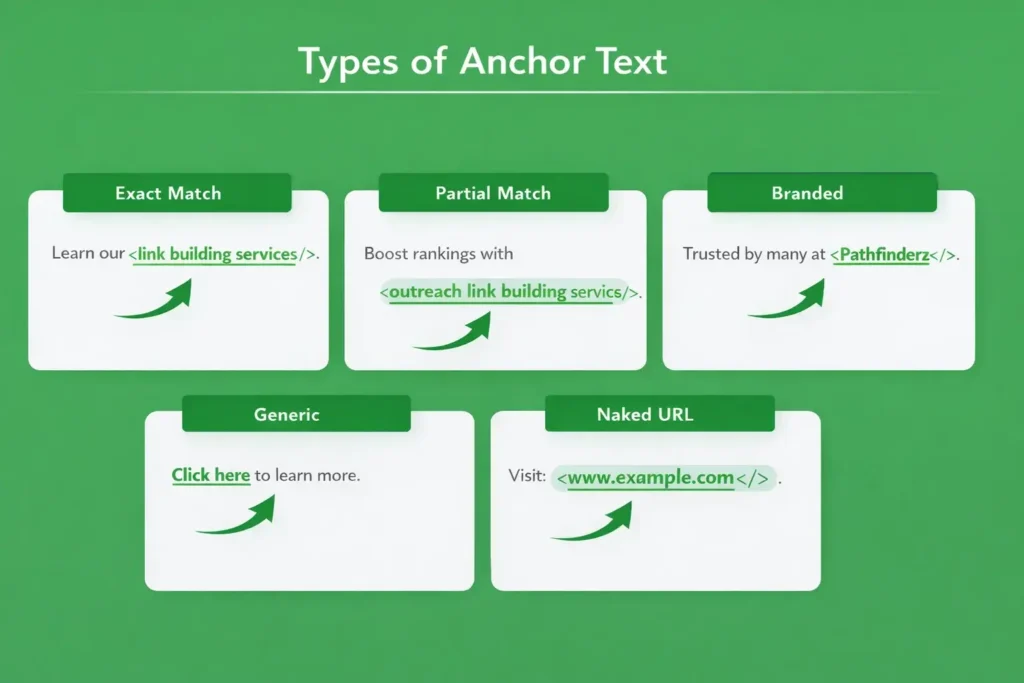
Exact Match Anchor Text
This uses the exact keyword of the target page.
Example:
- “link building strategies” → links to a page about link building strategies
Use it carefully. Too many exact matches can trigger spam signals.
Partial Match Anchor Text
This includes the keyword with extra words.
Example:
- “simple link building strategies for beginners”
This feels more natural and works well in most cases.
Branded Anchor Text
This uses a brand name as the link.
Example:
- “Ahrefs” linking to their homepage
This is the safest type for backlinks. It builds trust and authority.
Generic Anchor Text
These are non-descriptive phrases.
Examples:
- click here
- read more
- this page
They help with flow but give no SEO value. Use them sparingly.
Naked URL Anchor Text
This shows the raw URL as the link.
Example:
Best used for citations or references, not within content paragraphs.
Related Keyword Anchors
These use semantically related terms.
Example:
- “SEO link signals” linking to a page about backlinks
This helps expand topical relevance without repeating keywords.
Image Anchor Text and Alt Text
When an image is clickable, its alt text acts as the anchor.
Example:
- An image with alt text “SEO audit checklist” linking to a guide
Always write descriptive alt text. Avoid empty or generic labels.
What a Natural Anchor Profile Looks Like
A healthy mix usually includes:
- Branded anchors as the majority
- Partial match anchors for relevance
- Few exact match anchors
- Occasional generic and URL anchors
If most links use the same wording, it looks manipulated.
Anchor Text vs Keywords in SEO Strategy
Keywords and anchor text are related, but they serve different roles. Keywords are what users type into search engines. Anchor text is how pages connect through links.
Why Anchor Text Is Not Just Keywords
Using keywords directly as link text can work, but overuse creates risk. Search engines expect natural language, not repeated keyword phrases.
For example:
- Keyword: “SEO audit tool”
- Better anchor: “use an SEO audit tool for site checks”
This adds context and reads naturally inside content.
How to Use Keywords Naturally in Anchor Text
Follow simple rules to keep anchors safe and effective:
- Place keywords inside a natural sentence
- Avoid forcing exact phrases repeatedly
- Use variations instead of repeating the same term
- Keep anchors short but meaningful
Simple Formula for Writing Good Anchor Text
Use this structure:
Anchor text = topic + context
Examples:
- “technical SEO checklist for beginners”
- “improve site speed with this guide”
This approach keeps links readable and relevant.
Common Mistake to Avoid
Do not treat anchor text like a ranking shortcut. If every link uses the same keyword phrase, patterns become obvious.
Instead, focus on how real writers link in content. That keeps your profile natural and stable.
How to Optimize Anchor Text Naturally
Good anchors read like part of the sentence. They should help the reader, not interrupt the flow.
Keep Anchor Text Relevant to the Target Page
Match the link text with the destination topic. If the page is about site audits, the link should reflect that clearly.
Example:
- “complete site audit checklist” works better than “learn more”
Relevance builds trust with both users and search engines.
Use Natural Language Instead of Forced Keywords
Write anchors the way people speak. Avoid stuffing keywords into short phrases.
Bad example:
- “best SEO tool cheap SEO tool online”
Better example:
- “compare SEO tools for your workflow”
Natural phrasing improves readability and reduces spam signals.
Keep Anchor Text Short and Clear
Short anchors perform better in most cases.
Aim for:
- 2 to 5 words
- clear meaning
- no filler words
Example:
- “backlink analysis guide” is better than a long sentence link
Use Variation Across Anchor Text
Do not repeat the same phrase again and again. Instead, rotate variations like:
- “link building guide”
- “how to build links”
- “effective link building methods”
This creates a natural anchor profile.
Avoid Over-Optimization Signals
Watch for patterns that look unnatural.
Common red flags:
- Too many exact match anchors
- Same anchor repeated across multiple pages
- Links placed without context
If links feel forced when reading, they likely need fixing.
Quick Checklist for Better Anchors
Before placing a link, ask:
- Does it match the page topic
- Does it read naturally in the sentence
- Would a real writer use this phrasing
If the answer is yes, the anchor is good.
Anchor Text Strategy by Page Type
Not every page should use the same linking style. Anchor choice depends on the goal of the page you are linking to.
Homepage Anchor Text Strategy
Homepage links should focus on trust, not keywords.
Use mostly:
- Brand name
- Website name
- Naked URL
Example:
- “Pathfinderz”
- “visit Pathfinderz”
This builds authority and looks natural in backlink profiles.
Service and Money Pages
Service pages carry higher risk with aggressive anchors.
Use safer variations like:
- brand + keyword
- partial match phrases
- natural sentence anchors
Example:
- “see their link building services”
- “work with a link building agency”
Avoid pushing exact keywords repeatedly to these pages.
Blog and Informational Pages
Informational pages are safer for keyword-focused anchors.
You can use:
- partial match anchors
- related keyword phrases
- descriptive anchors
Example:
- “on-page SEO checklist”
- “how internal linking works”
These pages naturally attract links, so variation matters more than precision.
Simple Rule to Follow
- Homepage → mostly branded
- Service pages → cautious and natural
- Blog pages → flexible and descriptive
If you treat all pages the same, patterns become easy to detect.
Anchor Text for Internal Links vs Backlinks
Internal links and backlinks behave differently. One is fully controlled. The other depends on external sites.
Internal Link Anchor Text Strategy
You control every internal link on your site. This makes internal linking a strong optimization opportunity. Use anchors that clearly describe the destination page.
Example:
- “technical SEO checklist” linking to a checklist page
- “keyword research guide” linking to a detailed guide
Good internal anchors help:
- search engines understand page structure
- users navigate between related topics
- important pages receive more authority
You can also vary anchors across pages to avoid repetition.
Backlink Anchor Text Strategy
Backlinks come from other websites. You cannot fully control how others link to you.
That is why natural patterns matter more than exact wording. Safe backlink anchors usually include:
- branded anchors
- natural phrases
- partial keyword variations
Example:
- “according to this SEO study”
- “see this guide on link building”
Key Difference Between Internal and External Anchors
- Internal links → full control, strategic placement
- Backlinks → limited control, focus on natural acquisition
For internal links, you can plan anchors in advance.
For backlinks, you focus on earning links that look editorial and natural.
Practical Tip
If you are building links manually:
- Avoid sending exact anchor instructions every time
- Suggest natural phrases instead
- Let context decide the final wording
This reduces risk and keeps your link profile balanced.
Anchor Text Distribution and Ratio Strategy
A single anchor type does not work across all links. Search engines expect variation across your link profile.
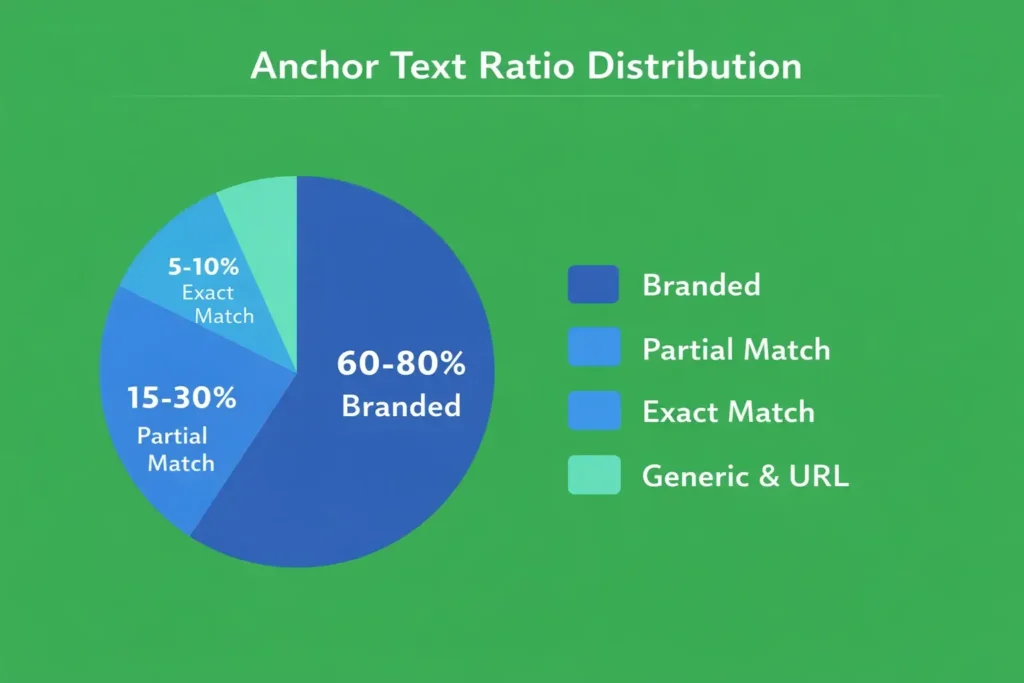
Safe Anchor Text Ratio for Most Websites
There is no fixed rule, but a safe structure looks like this:
- 60 to 80 percent branded and natural anchors
- 15 to 30 percent partial match anchors
- 5 to 10 percent exact match anchors
- small portion of generic and URL anchors
This keeps your profile balanced and avoids spam signals.
Anchor Distribution by Link Type
Different pages need different anchor mixes.
Homepage links:
- mostly branded and URL anchors
Service pages:
- mostly branded and partial match
- very few exact match anchors
Blog pages:
- more flexibility with descriptive anchors
- higher use of partial and related keywords
Why Variation Improves Rankings
Search engines compare patterns across many sites. A natural link profile shows:
- different anchor wording
- varied sentence structure
- links placed in context
If every link uses the same phrase, it looks artificial.
Simple Formula for Planning Anchors
Use this approach when building links:
Anchor plan = page type + risk level + variation
Example:
- Blog page → moderate keyword usage → high variation
- Service page → low keyword usage → high brand focus
Common Distribution Mistake
Many sites overuse exact keywords early. This creates a spike pattern in anchor usage. Instead, build a base of branded anchors first, then add variation over time.
Real Anchor Text Examples by Use Case
Theory helps, but real examples make decisions easier. Here are practical cases you can follow in daily SEO work.
Blog Content Linking Examples
Blog posts allow flexible and natural anchors.
Example:
You write about technical SEO and link to another guide.
- “technical SEO checklist”
- “improve crawl efficiency with this guide”
Both sound natural and fit the sentence. For internal linking, you can also connect related content like a comprehensive link building guide or an internal linking strategy article to strengthen topical relevance.
Guest Post and Link Building Examples
Guest posts require careful anchor placement. You want links to look editorial, not forced. Example inside a paragraph:
- “according to this detailed SEO study”
- “this guide explains link building basics”
Avoid placing exact keywords directly unless it fits naturally.
Bad example:
- “best link building services cheap”
Good example:
- “work with a trusted link building service”
SaaS and Service Page Examples
Service pages need safer anchors. Focus on clarity and trust instead of pushing keywords.
Examples:
- “explore their SEO services”
- “see how their agency builds backlinks”
These anchors feel natural and reduce risk.
What Good Anchor Placement Looks Like
A good anchor should:
- fit naturally in the sentence
- match the topic of the linked page
- provide clear expectation to the reader
If removing the link breaks the sentence flow, placement is wrong.
Quick Comparison
Weak anchors:
- click here
- this page
- read more
Strong anchors:
- “on-page SEO checklist”
- “backlink analysis guide”
- “keyword research process”
Use examples like these to guide your linking decisions.
Common Anchor Text Mistakes to Avoid
Most issues come from patterns, not single links. Fixing these mistakes improves both rankings and trust.
Over-Optimized Anchor Text
Using too many exact keywords is risky.
Example pattern:
- “link building services” repeated across many links
This creates a clear manipulation signal. Fix it by mixing variations and branded anchors.
Irrelevant Anchor Text
The link text must match the destination.
Bad example:
- “content marketing tips” linking to a pricing page
This confuses users and weakens relevance signals. Always match topic with destination page.
Repeating the Same Anchor Text
Using the same phrase again and again looks unnatural.
Example:
- Every link uses “SEO guide”
Instead, rotate variations like:
- “SEO checklist”
- “search optimization guide”
- “improving search rankings”
Variation keeps the profile natural.
Using Too Many Generic Anchors
Generic anchors provide no context.
Examples:
- click here
- read more
- this article
They are fine occasionally, but overuse weakens SEO value. Replace them with descriptive phrases whenever possible.
Linking Without Context
Dropping links randomly inside content reduces impact.
Bad example:
- placing a link without explaining why it exists
Good example:
- linking within a sentence that explains the value
Context around the link strengthens its signal.
Quick Self-Check
Before adding a link, ask:
- Does the text match the page
- Does it sound natural when read aloud
- Does it add value to the reader
If any answer is no, revise the anchor.
How to Detect Over-Optimized Anchor Text
Problems show up when patterns repeat across many links. You need to review your link profile, not just one page.
Signs of Over-Optimization
Watch for these signals:
- High percentage of exact match anchors
- Same phrase repeated across many referring domains
- Links pointing only to service or money pages
- Anchors placed without clear context
If multiple signs appear together, risk increases.
How to Audit Anchor Text Profile
Use common SEO tools to review anchor data.
Check:
- top anchors used across backlinks
- number of domains per anchor
- distribution of anchor types
Look for imbalance instead of small variations.
Simple Audit Formula
Use this quick check:
Risk level = repetition + keyword focus + low variation
Example:
- 50 links using the same keyword anchor → high risk
- mixed anchors with brand and phrases → low risk
This helps you spot issues fast.
How to Fix Anchor Text Issues
Fixing is about dilution, not removal.
Steps:
- build new links with branded anchors
- add partial match variations
- increase natural anchors over time
Avoid trying to change all old links. Instead, balance the overall profile gradually.
Edge Case to Understand
Some high authority sites rank with heavy exact anchors. That does not mean the strategy is safe for smaller sites.
Authority level changes how much risk a site can handle. For most sites, safer distribution works better long term.
Context and Surrounding Text in Anchor SEO
Link text does not work alone. Search engines read the full sentence and nearby content.
Role of Sentence and Paragraph Context
The words around a link add meaning. If the sentence supports the link topic, the signal becomes stronger.
Example:
- “improve crawl efficiency using this technical SEO checklist”
Here, both the anchor and sentence point to the same topic. If the sentence is unrelated, the signal weakens.
Placement of Anchor Text in Content
Placement affects both readability and SEO value.
Good placement:
- inside a relevant sentence
- near supporting information
- within the main content area
Avoid placing links:
- randomly between sentences
- inside unrelated paragraphs
- too close to multiple other links
Anchor Density Within a Section
Too many links in a small space create noise.
Example of poor structure:
- three links inside one short sentence
Better approach:
- space links across sections
- keep one clear link per idea
This improves clarity and user experience.
Context Formula for Strong Links
Use this simple structure:
Context = topic sentence + supporting words + anchor
Example:
- “to improve site performance, follow this page speed optimization guide”
The full sentence supports the link, not just the anchor.
Why This Matters More Today
Search engines now rely more on context than exact wording. Even if the anchor is generic, strong surrounding text can still help. That is why focusing only on keywords inside anchors is outdated.
Anchor Text for New vs Established Websites
Not every site can use the same linking approach. Risk tolerance depends on trust, authority, and link history.
Strategy for New Websites
New sites should stay conservative. Search engines do not fully trust fresh domains yet.
Use mostly:
- branded anchors
- natural sentence anchors
- partial match phrases
Avoid heavy keyword anchors early.Focus on building a clean and natural backlink profile first.
Strategy for Established Websites
Older sites have more flexibility. They already have authority and diverse link signals.
You can use:
- more partial match anchors
- occasional exact match anchors
- descriptive keyword phrases
Still avoid repeating the same keyword too often. Even strong sites can lose trust with aggressive patterns.
Key Difference in Approach
- New site → build trust first, avoid risk
- Established site → expand relevance with controlled variation
Practical Example
New site:
- “learn more about SEO basics”
- “visit this guide on link building”
Established site:
- “advanced link building strategies”
- “technical SEO audit checklist”
The difference is subtle but important.
Common Mistake
Many new sites try to rank faster with exact match anchors. This often leads to poor results or ignored links. A slower, natural approach works better long term.
Using Tools to Analyze Anchor Text
You do not need complex setups to review anchor data. Basic reports from common tools are enough to spot patterns.
Tools for Anchor Text Analysis
Use these platforms to review your link profile:
- Ahrefs for anchor distribution and referring domains
- SEMrush for backlink overview and anchor reports
- Moz for anchor text summaries
- Google Search Console for top linking text
Each tool shows how other sites link to your pages.
What to Check in Anchor Reports
Focus on patterns, not individual links.
Check:
- most used anchor phrases
- number of domains using the same anchor
- balance between branded and keyword anchors
- presence of generic or irrelevant anchors
This gives a clear view of your profile health.
Simple Review Process
Follow this quick workflow:
- export anchor text list
- group anchors by type
- calculate percentage of each group
Example:
If 70 percent anchors are branded, the profile looks natural. If 40 percent are exact keywords, risk increases.
Fixing Issues Using Data
Once you identify imbalance, adjust your future links. Do not try to edit every existing backlink.
Instead:
- build new links with safer anchors
- increase variation over time
- focus on natural phrasing
Check anchor data monthly. Small adjustments over time are safer than sudden changes.
Advanced Anchor Text Strategy for Link Building
At scale, small mistakes repeat fast. You need a clear plan before building links.
Planning Anchor Text for Campaigns
Start with a simple mapping sheet.
Include:
- target page
- anchor variation
- anchor type
- link source
Example plan:
- Page: blog guide
- Anchor: “technical SEO checklist”
- Type: partial match
This keeps your distribution controlled from the start.
Anchor Text for Guest Posts and Niche Edits
When placing links on other sites, keep anchors natural.
Good approach:
- suggest 2 to 3 anchor options
- let the editor choose what fits the content
- avoid forcing exact keywords
Example:
- “this SEO guide explains the process”
- “learn more about link building here”
These blend into content better than rigid phrases.
Scaling Anchor Text Across Multiple Links
When building many links, variation becomes critical. Do not repeat the same anchor text.
Instead:
- rotate keyword variations
- mix branded and natural anchors
- change sentence structure
Example rotation:
- “link building strategies”
- “how to build backlinks”
- “effective backlink methods”
This avoids patterns that look automated.
Using Page Titles as Anchors
A simple and safe method is using page titles.
Example:
- linking a post using its exact title
This feels natural and often matches how real writers link.
Advanced Insight Most Miss
Anchor text works together with:
- surrounding text
- page topic
- link placement
Even a weak anchor can perform well if context is strong. That is why focusing only on anchor wording is not enough.
FAQs About Anchor Text SEO
Conclusion
Anchor text optimization works best when it stays natural and relevant. Focus on clear wording, variation, and strong context around each link.
Avoid shortcuts like keyword stuffing or repeated anchor phrases. A balanced approach improves both user experience and search visibility over time.