What Is URL Rating? The Ahrefs UR Score Meaning and How to Improve It
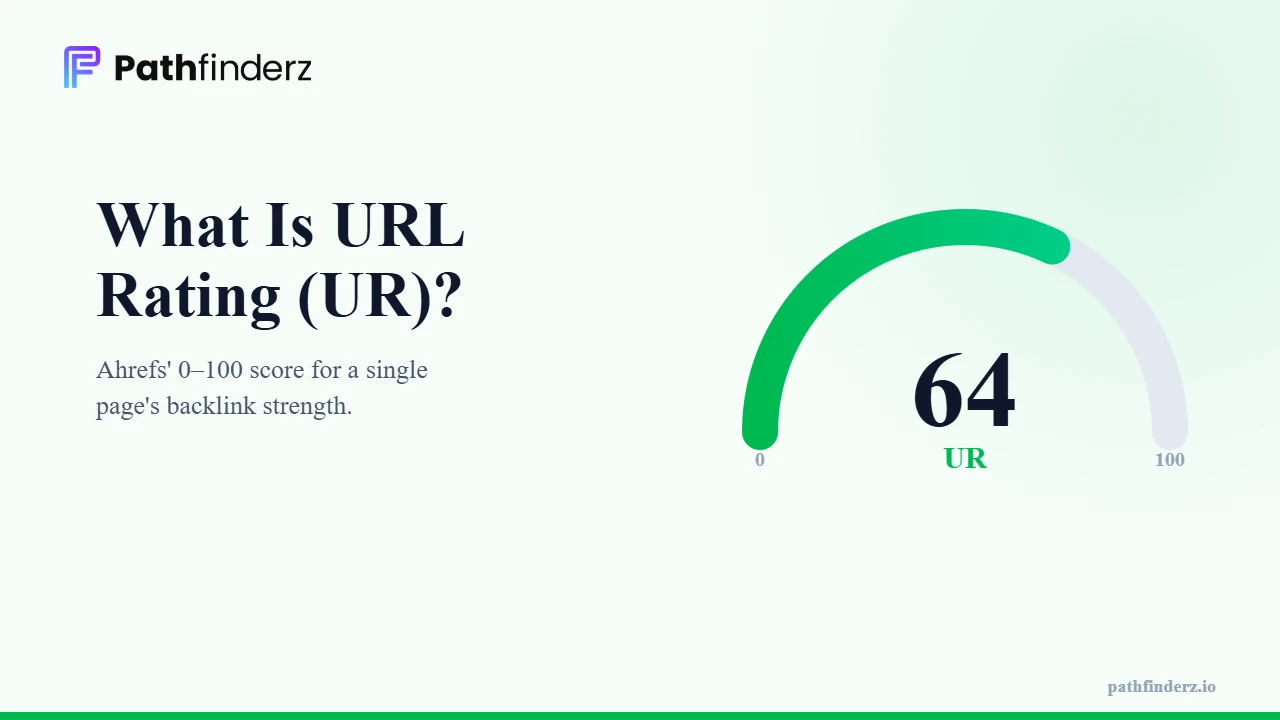
URL rating is an Ahrefs metric that measures the link strength of a single page. It runs on a 0 to 100 scale. A higher score means a stronger backlink profile for that URL. SEOs often call it UR for short. Ahrefs built it to work like Google’s old PageRank. This guide explains what the UR score means in plain terms. You will learn how Ahrefs calculates it and what a good score looks like. You will also see how it differs from domain rating.
What Is URL Rating (UR)?
UR is a score from Ahrefs. It rates the backlink strength of one web page. The score runs from 0 to 100. People also search for it as ahrefs url rating or ur rating. A score near 100 is very strong.
Think of UR as a page-level power score. It only counts the links pointing to that exact URL. It ignores your content, keywords, and page speed. To learn the basics first, read our guide on what backlinks are.
How Is UR Calculated?
Ahrefs keeps the exact formula private. The score works much like Google PageRank. It flows link value from page to page across the web. A few clear factors shape the number.
- Only follow links pass value. Nofollow, sponsored, and UGC links are ignored.
- Both internal and external links count, weighted differently.
- The strength of the linking page matters, not just the count.
- Spam signals and a damping factor reduce the value passed.
Ahrefs spreads this url rating distribution across every linked page. The 0 to 100 scale is logarithmic. Moving from 20 to 30 is easier than 70 to 80.
What Is a Good URL Rating Score?
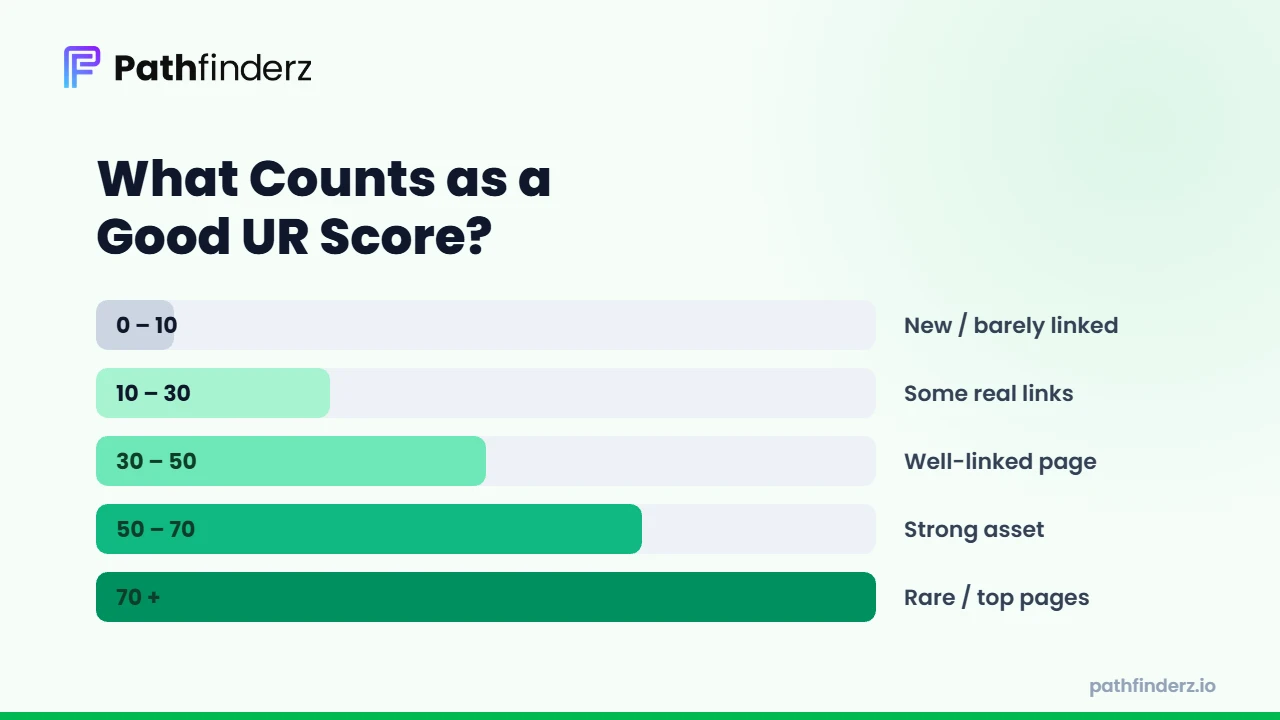
There is no fixed number that counts as a good UR. A good score is relative to the pages you compete with. Aim a few points above the pages outranking you. These rough bands give you a sense of scale.
| 0 to 10 | New or barely linked page. |
| 10 to 30 | A page with some real links. |
| 30 to 50 | A well-linked page or guide. |
| 50 to 70 | A strong, established asset. |
| 70 and up | Rare. Major pages and homepages. |
Compare similar pages in your niche, not giant brands. A UR of 30 can be strong in one niche and average in another.
URL Rating vs Domain Rating
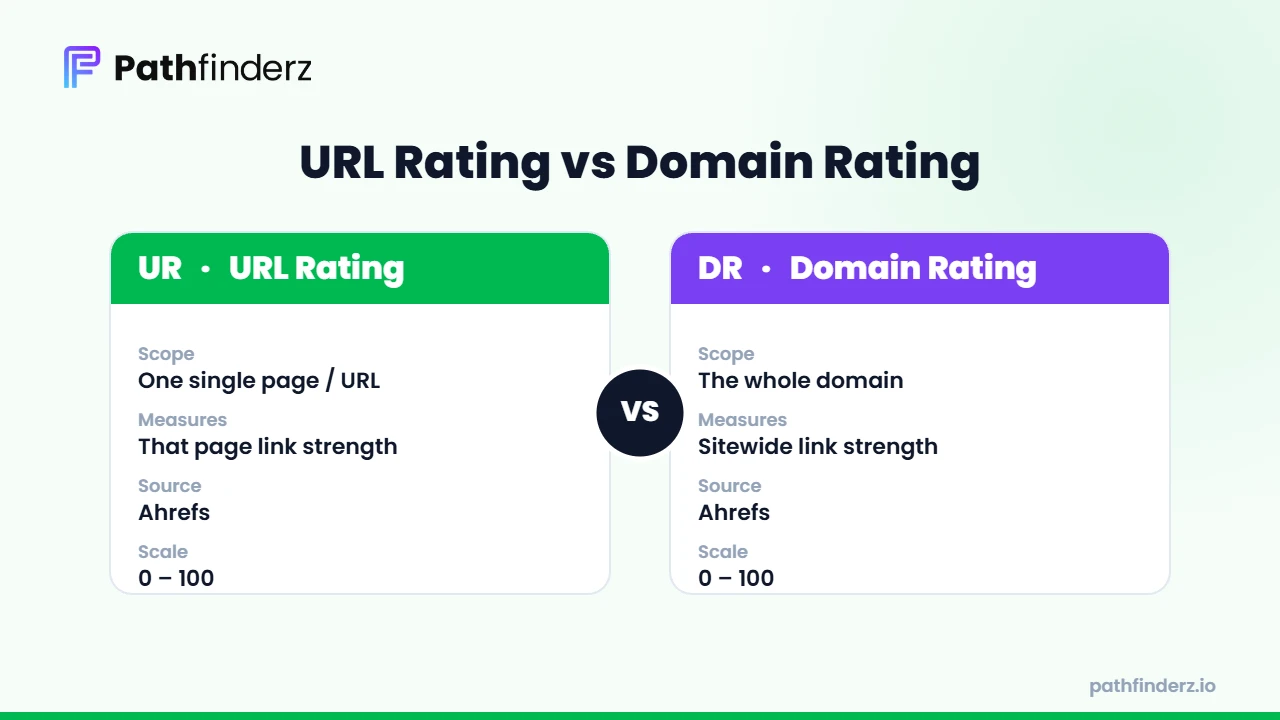
UR and domain rating are both Ahrefs metrics. UR scores a single page. DR scores the whole domain. A page can have a higher UR than its site DR.
This happens when one page earns strong links of its own. Use UR to judge a page, and DR to judge the domain. Both run on the same 0 to 100 scale.
UR vs Page Authority
UR is the Ahrefs version of a page score. Page authority is the Moz version. Both rate one page from 0 to 100. They use different link data, so the numbers rarely match. Pick one tool and track the trend inside it.
How to Check Your UR Score
You can check the score inside Ahrefs Site Explorer. Paste any URL and Ahrefs returns its current UR. The free Ahrefs Webmaster Tools also show it. Track your key pages over time. Watch the trend rather than one single reading.
How to Improve Your URL Rating
Your UR rises when the links to a page get stronger. On-page changes alone will not move it. Focus on earning quality follow links.
Earn follow backlinks
Publish content worth citing, like data or free tools. Only follow links pass value, so chase those. Our guide on linkable assets shows how.
Build internal links
Link from your strongest pages to the page you want to lift. Use clear anchor text in those links.
Clean up spam links
Remove or disavow spammy links that drag the page down. Build authority backlinks the clean way instead.
Why Did My UR Go Down?
A UR score can drop without any warning. A few common reasons explain most changes.
- You lost backlinks that used to point to the page.
- Linking pages lost their own links and passed less value.
- Ahrefs refreshed its index and recalculated scores.
- A redirect or URL change split the link signals.
A small dip is normal and is not a penalty.
Is UR a Google Ranking Factor?
UR is not a Google ranking factor. Google does not use Ahrefs scores in its algorithm. Ahrefs studies show UR correlates with higher rankings. That link is a signal, not proof of cause. Treat it as a useful guide, not Google’s verdict.
Frequently Asked Questions
What does URL rating stand for?
It stands for the Ahrefs UR metric. It scores the link strength of one single page.
Can UR be higher than domain rating?
Yes. A single page can out-earn its own domain in links. A strong page often beats a weak site score.
Is a higher UR always better?
A higher score signals a stronger link profile. It does not promise better content or rankings.
How often does the score update?
Ahrefs refreshes its index on a regular cycle. Expect periodic shifts, not daily moves.
Conclusion
URL rating is a handy Ahrefs metric for judging one page’s link power. It will not replace real rankings or strong content. Earn quality follow links, add smart internal links, and clean up spam. Do that and your score will climb over time. Pair it with domain rating and page authority for the full picture, and anchor it to solid link building.